Actually Tenet resigned, but the author of this article has secret sources throughout the White House that tell him otherwise. This article is a bunch of crap.
From Capitol Hill Blue
Bush Leagues
Bush Fires, Then Praises, CIA Chief Tenet
By Staff and Wire Reports
Jun 3, 2004, 16:19
President George W. Bush fired CIA Director George Tenet Wednesday, but allowed the beleagured intelligence chief to save face by resigning "for personal reasons."
Tenet, buffeted by controversies over intelligence lapses about suspected weapons of mass destruction in Iraq and the Sept. 11 terrorist attacks, resigned after an hour-long meeting with Bush. White House sources say Bush asked for the CIA director's resignation.
President Bush continued the charade on Thursday, announcing at a hastily-arranged appearance that Tenet was leaving for personal reasons and "I will miss him."
"Yeah, the President will miss Tenet like a boil on his butt," one White House aide confided today. "He had to go."
Bush announced the news in a hurriedly arranged appearance before television cameras before leaving on a trip to Europe.
Tenet's ouster came amid new storms over intelligence issues, including an alleged Pentagon leak of highly classified intelligence to Ahmad Chalabi, an Iraqi politician. At the same time, a federal grand jury is pressing its investigation of the leak of a CIA operative's name, and Bush acknowledged he might be questioned in the case.
The CIA denied that Tenet's resignation was connected with any of the those issues. "Absolutely not," said Mark Mansfield, CIA spokesman.
Tenet addressed CIA employees and said, "It was a personal decision, and had only one basis in fact: the well being of my wonderful family, nothing more and nothing less."
The news caught Washington by surprise. Bush informed his senior staff Thursday morning at an Oval Office meeting that included Vice President Dick Cheney, Secretary of State Colin Powell and Condoleezza Rice, the national security adviser. The president told his staff that the official story is that Tenet was leaving for personal reasons.
"He told me he was resigning for personal reasons. I told him I'm sorry he's leaving. He's done a superb job on behalf of the American people," the president said at a hurriedly arranged announcement before boarding a helicopter to begin a trip to Europe. Inside the West Wing, staffers joked about the President's ability to keep a straight face during the televised announcement.
Cheney stood outside the Oval Office to watch Bush's announcement and issued a carefully-worded statement later expressing regret that Tenet was leaving. "I have enjoyed working closely with him and believe he's done a superb job on behalf of the nation," Cheney said.
Tenet and Bush once had a close relationship. The CIA director came to the White House most mornings to personally brief the president on intelligence matters. At one of those sessions in December, 2002, the CIA listed evidence of Iraq's weapons of mass destruction. Unsure that Americans would find the information compelling, Bush turned to Tenet. "It's a slam-dunk case," Tenet replied. No weapons have ever been found and Bush now blames Tenet for the political morass that Iraq has become.
Sen. John Kerry, Bush's likely Democratic opponent in this fall's elections, said Tenet "has worked extremely hard on behalf of our nation."
"There is no question, however, that there have been significant intelligence failures, and the administration has to accept responsibility for those failures," he said.
"He was caught in a difficult situation...trying to manage a 20th century intelligence community infrastructure to meet 21st century threats. This was not his fault," said Sen. Chuck Hagel, R-Neb.
Tenet will serve until mid-July. Bush said that deputy, John McLaughlin, will temporarily lead America's premier spy agency until a successor is found. Among possible successors is House Intelligence Committee Chairman Porter Goss, R-Fla., a former CIA agent, and McLaughlin.
Tenet had given some consideration to leaving last summer, but decided to stay on. Some close to him believe he wanted to catch al-Qaida leader Osama bin Laden, who remains at large and is believed to be on the Afghan-Pakistani border.
Like many who resign from government, Tenet plans to take time off with his family, and eventually pursue public speaking, teaching, writing or working in the private sector, according to the officials close to him.
"He's been a strong and able leader at the agency. and I will miss him," Bush said of Tenet as he got ready to board Marine One for a trip to Andrews Air Force Base, Md., and on to Europe.
"George Tenet is the kind of public servant you like to work with," the president added. "He's strong, he's resolute. He's served his nation as the director for seven years. He has been a strong and able leader at the agency. He's been a strong leader in the war on terror."
FBI Director Robert S. Mueller III praised Tenet. "George has sought at every turn to bridge the gap between the CIA and FBI with one goal in mind - the security of the American public," Mueller said. "Due to his constant efforts to bring the intelligence agencies closer together, we are better able to predict the actions of our adversaries and to protect Americans from evolving transnational threats."
But Sen. Pat Roberts, R-Kansas, chairman of the Senate Intelligence Committee, said the intelligence community had to be held accountable for its failings.
"Simply put, I think the community is somewhat in denial over the full extent ... of the shortcoming of its work on Iraq and also on 9/11," Roberts, unaware of Tenet's decision, said at a breakfast Thursday, "We need fresh thinking within the community, especially within the Congress, to enable the intelligence community to change and adapt to the dangerous world in which we live."
Tenet had been under fire for months in connection with intelligence failures related to the U.S.-led war against Iraq, specifically assertions the United States made about Saddam Hussein's purported possession of weapons of mass destruction, and with respect to the threat from al-Qaida.
In April, a panel investigating the Sept. 11 attacks released statements harshly criticizing the CIA for failing to fully appreciate the threat posed by al-Qaida before the terrorist hijackings. Tenet told the panel the intelligence-gathering flaws exposed by the attacks will take five years to correct.
"I'm surprised," said Senate Minority Leader Tom Daschle. "I don't think anyone saw it coming. I think we need to know more about the reasons why this surprise announcement came today," the South Dakota Democrat said.
"Mr. Tenet's been under very harsh criticism. I think clearly he's been under great pressure and some criticism. Whether or not that's a factor is not something I can comment on," Daschle said.
Rep. Jane Harman, D-Calif., ranking Democrat on the House Intelligence Committee, said Tenet "restored morale and provided stability and continuity at a crucial time."
"I have been critical of the prewar intelligence on Iraq's WMD and ties to terror, as well as failures leading up to the attacks of 9-11," she noted. "With Tenet's departure, the president has the opportunity to fix these problems by transforming the job that Tenet held."
Said Goss: "Just boat loads of stuff have been dumped on him by all kinds of people. He was given the job of rebuilding an agency that had been depleted."
House Speaker Dennis Hastert said: "He served his country a long time. History will tell what the implications of his tenure were."
"I think history will tell," the Illinois Republican said when asked how Tenet's performance would be judged. "It's too early to make that snap judgment."
"I think history will either vindicate him or say, 'Hey there was a problem there'," Hastert said.
Retired Adm. Stansfield Turner said he thought Tenet was pushed out.
"I think the president feels he's in enough trouble that he's got to begin to cast some of the blame for the morass that we are in in Iraq to somebody else, and this was one subtle way to do it," said Turner, himself a former CIA director.
© Copyright 2004 Capitol Hill Blue
Thursday, June 10, 2004


Wednesday, June 09, 2004
Try this: both Bushes CREATED the wars. Yep.
"I think he gets more joy, he gets a bigger rush, out of doing world war," she said of Bush. "The United States economy just bores him or confuses him, I guess."
Patricia Smith, 70, a Republican in Newport News, sensed the same problem: "He's gotten so overwhelmed with these other things that he's forgotten what he promised he would do for us."
Gee. Deja vu.
See the common paths, two men, wealthy and pampered, out of touch with people-America, their lives cushioned and padded with stuffed sychophant:
Saddam Hussein was a snake (and who isn't) and he was provoked in the first Gulf War, and given the go ahead* by a bumbling state department.
Then 9/11 which with which Saddam had significantly less to do with (if anything at all)than the ineptitude of our own security under Star Wars and Drill for Oil! Bush administration.
Two presidents, father and son, both go to war, on the same country, both fouling it up but rather liking the whole war game stuff and, oh, the US isn't really very interesting: taking care of a bunch of loser Americans, looking for work, worrying about education and clean air: bor-ing!
It's deadly clear this war in Iraq is of George Bushes choosing. What now becomes clear is that the first Gulf War of George Bush Sr. Choosing: these guys like war! Shit, Shrub so much as said it.
*yep, that's true. Iraq was told by the US that their dealings with Kuwait was in internal problem: there was NO suggestion that, with troops moving, that there would be dire consequence if Kuwait were invaded. Nope, we watched it happen, and were in full diplomatic contact with Iraq prior to their invasion of Kuwait.
Patricia Smith, 70, a Republican in Newport News, sensed the same problem: "He's gotten so overwhelmed with these other things that he's forgotten what he promised he would do for us."
Gee. Deja vu.
See the common paths, two men, wealthy and pampered, out of touch with people-America, their lives cushioned and padded with stuffed sychophant:
Saddam Hussein was a snake (and who isn't) and he was provoked in the first Gulf War, and given the go ahead* by a bumbling state department.
Then 9/11 which with which Saddam had significantly less to do with (if anything at all)than the ineptitude of our own security under Star Wars and Drill for Oil! Bush administration.
Two presidents, father and son, both go to war, on the same country, both fouling it up but rather liking the whole war game stuff and, oh, the US isn't really very interesting: taking care of a bunch of loser Americans, looking for work, worrying about education and clean air: bor-ing!
It's deadly clear this war in Iraq is of George Bushes choosing. What now becomes clear is that the first Gulf War of George Bush Sr. Choosing: these guys like war! Shit, Shrub so much as said it.
*yep, that's true. Iraq was told by the US that their dealings with Kuwait was in internal problem: there was NO suggestion that, with troops moving, that there would be dire consequence if Kuwait were invaded. Nope, we watched it happen, and were in full diplomatic contact with Iraq prior to their invasion of Kuwait.
Cold Turkey
By Kurt Vonnegut
In These Times (Web Ezine)
Monday 10 May 2004
Many years ago, I was so innocent I still considered it possible that we could become the humane and reasonable America so many members of my generation used to dream of. We dreamed of such an America during the Great Depression, when there were no jobs. And then we fought and often died for that dream during the Second World War, when there was no peace.
But I know now that there is not a chance in hell of America's becoming humane and reasonable. Because power corrupts us, and absolute power corrupts absolutely. Human beings are chimpanzees who get crazy drunk on power. By saying that our leaders are power-drunk chimpanzees, am I in danger of wrecking the morale of our soldiers fighting and dying in the Middle East? Their morale, like so many bodies, is already shot to pieces. They are being treated, as I never was, like toys a rich kid got for Christmas.
When you get to my age, if you get to my age, which is 81, and if you have reproduced, you will find yourself asking your own children, who are themselves middle-aged, what life is all about. I have seven kids, four of them adopted.
Many of you reading this are probably the same age as my grandchildren. They, like you, are being royally shafted and lied to by our Baby Boomer corporations and government.
I put my big question about life to my biological son Mark. Mark is a pediatrician, and author of a memoir, The Eden Express. It is about his crackup, straightjacket and padded cell stuff, from which he recovered sufficiently to graduate from Harvard Medical School.
Dr. Vonnegut said this to his doddering old dad: "Father, we are here to help each other get through this thing, whatever it is." So I pass that on to you. Write it down, and put it in your computer, so you can forget it.
I have to say that's a pretty good sound bite, almost as good as, "Do unto others as you would have them do unto you." A lot of people think Jesus said that, because it is so much the sort of thing Jesus liked to say. But it was actually said by Confucius, a Chinese philosopher, 500 years before there was that greatest and most humane of human beings, named Jesus Christ.
The Chinese also gave us, via Marco Polo, pasta and the formula for gunpowder. The Chinese were so dumb they only used gunpowder for fireworks. And everybody was so dumb back then that nobody in either hemisphere even knew that there was another one.
But back to people, like Confucius and Jesus and my son the doctor, Mark, who've said how we could behave more humanely, and maybe make the world a less painful place. One of my favorites is Eugene Debs, from Terre Haute in my native state of Indiana. Get a load of this:
Eugene Debs, who died back in 1926, when I was only 4, ran 5 times as the Socialist Party candidate for president, winning 900,000 votes, 6 percent of the popular vote, in 1912, if you can imagine such a ballot. He had this to say while campaigning:
As long as there is a lower class, I am in it.
As long as there is a criminal element, I'm of it.
As long as there is a soul in prison, I am not free.
Doesn't anything socialistic make you want to throw up? Like great public schools or health insurance for all?
How about Jesus' Sermon on the Mount, the Beatitudes?
Blessed are the meek, for they shall inherit the Earth.
Blessed are the merciful, for they shall obtain mercy.
Blessed are the peacemakers, for they shall be called the children of God. ...
And so on.
Not exactly planks in a Republican platform. Not exactly Donald Rumsfeld or Dick Cheney stuff.
For some reason, the most vocal Christians among us never mention the Beatitudes. But, often with tears in their eyes, they demand that the Ten Commandments be posted in public buildings. And of course that's Moses, not Jesus. I haven't heard one of them demand that the Sermon on the Mount, the Beatitudes, be posted anywhere.
"Blessed are the merciful" in a courtroom? "Blessed are the peacemakers" in the Pentagon? Give me a break!
There is a tragic flaw in our precious Constitution, and I don't know what can be done to fix it. This is it: Only nut cases want to be president.
But, when you stop to think about it, only a nut case would want to be a human being, if he or she had a choice. Such treacherous, untrustworthy, lying and greedy animals we are!
I was born a human being in 1922 A.D. What does "A.D." signify? That commemorates an inmate of this lunatic asylum we call Earth who was nailed to a wooden cross by a bunch of other inmates. With him still conscious, they hammered spikes through his wrists and insteps, and into the wood. Then they set the cross upright, so he dangled up there where even the shortest person in the crowd could see him writhing this way and that.
Can you imagine people doing such a thing to a person?
No problem. That's entertainment. Ask the devout Roman Catholic Mel Gibson, who, as an act of piety, has just made a fortune with a movie about how Jesus was tortured. Never mind what Jesus said.
During the reign of King Henry the Eighth, founder of the Church of England, he had a counterfeiter boiled alive in public. Show biz again.
Mel Gibson's next movie should be The Counterfeiter. Box office records will again be broken.
One of the few good things about modern times: If you die horribly on television, you will not have died in vain. You will have entertained us.
And what did the great British historian Edward Gibbon, 1737-1794 A.D., have to say about the human record so far? He said, "History is indeed little more than the register of the crimes, follies and misfortunes of mankind."
The same can be said about this morning's edition of the New York Times.
The French-Algerian writer Albert Camus, who won a Nobel Prize for Literature in 1957, wrote, "There is but one truly serious philosophical problem, and that is suicide."
So there's another barrel of laughs from literature. Camus died in an automobile accident. His dates? 1913-1960 A.D.
Listen. All great literature is about what a bummer it is to be a human being: Moby Dick, Huckleberry Finn, The Red Badge of Courage, the Iliad and the Odyssey, Crime and Punishment, the Bible and The Charge of the Light Brigade.
But I have to say this in defense of humankind: No matter in what era in history, including the Garden of Eden, everybody just got there. And, except for the Garden of Eden, there were already all these crazy games going on, which could make you act crazy, even if you weren't crazy to begin with. Some of the games that were already going on when you got here were love and hate, liberalism and conservatism, automobiles and credit cards, golf and girls' basketball.
Even crazier than golf, though, is modern American politics, where, thanks to TV and for the convenience of TV, you can only be one of two kinds of human beings, either a liberal or a conservative.
Actually, this same sort of thing happened to the people of England generations ago, and Sir William Gilbert, of the radical team of Gilbert and Sullivan, wrote these words for a song about it back then:
I often think it's comical
How nature always does contrive
That every boy and every gal
That's born into the world alive
Is either a little Liberal
Or else a little Conservative.
Which one are you in this country? It's practically a law of life that you have to be one or the other? If you aren't one or the other, you might as well be a doughnut.
If some of you still haven't decided, I'll make it easy for you.
If you want to take my guns away from me, and you're all for murdering fetuses, and love it when homosexuals marry each other, and want to give them kitchen appliances at their showers, and you're for the poor, you're a liberal.
If you are against those perversions and for the rich, you're a conservative.
What could be simpler?
My government's got a war on drugs. But get this: The two most widely abused and addictive and destructive of all substances are both perfectly legal.
One, of course, is ethyl alcohol. And President George W. Bush, no less, and by his own admission, was smashed or tiddley-poo or four sheets to the wind a good deal of the time from when he was 16 until he was 41. When he was 41, he says, Jesus appeared to him and made him knock off the sauce, stop gargling nose paint.
Other drunks have seen pink elephants.
And do you know why I think he is so pissed off at Arabs? They invented algebra. Arabs also invented the numbers we use, including a symbol for nothing, which nobody else had ever had before. You think Arabs are dumb? Try doing long division with Roman numerals.
We're spreading democracy, are we? Same way European explorers brought Christianity to the Indians, what we now call "Native Americans."
How ungrateful they were! How ungrateful are the people of Baghdad today.
So let's give another big tax cut to the super-rich. That'll teach bin Laden a lesson he won't soon forget. Hail to the Chief.
That chief and his cohorts have as little to do with Democracy as the Europeans had to do with Christianity. We the people have absolutely no say in whatever they choose to do next. In case you haven't noticed, they've already cleaned out the treasury, passing it out to pals in the war and national security rackets, leaving your generation and the next one with a perfectly enormous debt that you'll be asked to repay.
Nobody let out a peep when they did that to you, because they have disconnected every burglar alarm in the Constitution: The House, the Senate, the Supreme Court, the FBI, the free press (which, having been embedded, has forsaken the First Amendment) and We the People.
About my own history of foreign substance abuse. I've been a coward about heroin and cocaine and LSD and so on, afraid they might put me over the edge. I did smoke a joint of marijuana one time with Jerry Garcia and the Grateful Dead, just to be sociable. It didn't seem to do anything to me, one way or the other, so I never did it again. And by the grace of God, or whatever, I am not an alcoholic, largely a matter of genes. I take a couple of drinks now and then, and will do it again tonight. But two is my limit. No problem.
I am of course notoriously hooked on cigarettes. I keep hoping the things will kill me. A fire at one end and a fool at the other.
But I'll tell you one thing: I once had a high that not even crack cocaine could match. That was when I got my first driver's license! Look out, world, here comes Kurt Vonnegut.
And my car back then, a Studebaker, as I recall, was powered, as are almost all means of transportation and other machinery today, and electric power plants and furnaces, by the most abused and addictive and destructive drugs of all: fossil fuels.
When you got here, even when I got here, the industrialized world was already hopelessly hooked on fossil fuels, and very soon now there won't be any more of those. Cold turkey.
Can I tell you the truth? I mean this isn't like TV news, is it?
Here's what I think the truth is: We are all addicts of fossil fuels in a state of denial, about to face cold turkey.
And like so many addicts about to face cold turkey, our leaders are now committing violent crimes to get what little is left of what we're hooked on.
In These Times (Web Ezine)
Monday 10 May 2004
Many years ago, I was so innocent I still considered it possible that we could become the humane and reasonable America so many members of my generation used to dream of. We dreamed of such an America during the Great Depression, when there were no jobs. And then we fought and often died for that dream during the Second World War, when there was no peace.
But I know now that there is not a chance in hell of America's becoming humane and reasonable. Because power corrupts us, and absolute power corrupts absolutely. Human beings are chimpanzees who get crazy drunk on power. By saying that our leaders are power-drunk chimpanzees, am I in danger of wrecking the morale of our soldiers fighting and dying in the Middle East? Their morale, like so many bodies, is already shot to pieces. They are being treated, as I never was, like toys a rich kid got for Christmas.
When you get to my age, if you get to my age, which is 81, and if you have reproduced, you will find yourself asking your own children, who are themselves middle-aged, what life is all about. I have seven kids, four of them adopted.
Many of you reading this are probably the same age as my grandchildren. They, like you, are being royally shafted and lied to by our Baby Boomer corporations and government.
I put my big question about life to my biological son Mark. Mark is a pediatrician, and author of a memoir, The Eden Express. It is about his crackup, straightjacket and padded cell stuff, from which he recovered sufficiently to graduate from Harvard Medical School.
Dr. Vonnegut said this to his doddering old dad: "Father, we are here to help each other get through this thing, whatever it is." So I pass that on to you. Write it down, and put it in your computer, so you can forget it.
I have to say that's a pretty good sound bite, almost as good as, "Do unto others as you would have them do unto you." A lot of people think Jesus said that, because it is so much the sort of thing Jesus liked to say. But it was actually said by Confucius, a Chinese philosopher, 500 years before there was that greatest and most humane of human beings, named Jesus Christ.
The Chinese also gave us, via Marco Polo, pasta and the formula for gunpowder. The Chinese were so dumb they only used gunpowder for fireworks. And everybody was so dumb back then that nobody in either hemisphere even knew that there was another one.
But back to people, like Confucius and Jesus and my son the doctor, Mark, who've said how we could behave more humanely, and maybe make the world a less painful place. One of my favorites is Eugene Debs, from Terre Haute in my native state of Indiana. Get a load of this:
Eugene Debs, who died back in 1926, when I was only 4, ran 5 times as the Socialist Party candidate for president, winning 900,000 votes, 6 percent of the popular vote, in 1912, if you can imagine such a ballot. He had this to say while campaigning:
As long as there is a lower class, I am in it.
As long as there is a criminal element, I'm of it.
As long as there is a soul in prison, I am not free.
Doesn't anything socialistic make you want to throw up? Like great public schools or health insurance for all?
How about Jesus' Sermon on the Mount, the Beatitudes?
Blessed are the meek, for they shall inherit the Earth.
Blessed are the merciful, for they shall obtain mercy.
Blessed are the peacemakers, for they shall be called the children of God. ...
And so on.
Not exactly planks in a Republican platform. Not exactly Donald Rumsfeld or Dick Cheney stuff.
For some reason, the most vocal Christians among us never mention the Beatitudes. But, often with tears in their eyes, they demand that the Ten Commandments be posted in public buildings. And of course that's Moses, not Jesus. I haven't heard one of them demand that the Sermon on the Mount, the Beatitudes, be posted anywhere.
"Blessed are the merciful" in a courtroom? "Blessed are the peacemakers" in the Pentagon? Give me a break!
There is a tragic flaw in our precious Constitution, and I don't know what can be done to fix it. This is it: Only nut cases want to be president.
But, when you stop to think about it, only a nut case would want to be a human being, if he or she had a choice. Such treacherous, untrustworthy, lying and greedy animals we are!
I was born a human being in 1922 A.D. What does "A.D." signify? That commemorates an inmate of this lunatic asylum we call Earth who was nailed to a wooden cross by a bunch of other inmates. With him still conscious, they hammered spikes through his wrists and insteps, and into the wood. Then they set the cross upright, so he dangled up there where even the shortest person in the crowd could see him writhing this way and that.
Can you imagine people doing such a thing to a person?
No problem. That's entertainment. Ask the devout Roman Catholic Mel Gibson, who, as an act of piety, has just made a fortune with a movie about how Jesus was tortured. Never mind what Jesus said.
During the reign of King Henry the Eighth, founder of the Church of England, he had a counterfeiter boiled alive in public. Show biz again.
Mel Gibson's next movie should be The Counterfeiter. Box office records will again be broken.
One of the few good things about modern times: If you die horribly on television, you will not have died in vain. You will have entertained us.
And what did the great British historian Edward Gibbon, 1737-1794 A.D., have to say about the human record so far? He said, "History is indeed little more than the register of the crimes, follies and misfortunes of mankind."
The same can be said about this morning's edition of the New York Times.
The French-Algerian writer Albert Camus, who won a Nobel Prize for Literature in 1957, wrote, "There is but one truly serious philosophical problem, and that is suicide."
So there's another barrel of laughs from literature. Camus died in an automobile accident. His dates? 1913-1960 A.D.
Listen. All great literature is about what a bummer it is to be a human being: Moby Dick, Huckleberry Finn, The Red Badge of Courage, the Iliad and the Odyssey, Crime and Punishment, the Bible and The Charge of the Light Brigade.
But I have to say this in defense of humankind: No matter in what era in history, including the Garden of Eden, everybody just got there. And, except for the Garden of Eden, there were already all these crazy games going on, which could make you act crazy, even if you weren't crazy to begin with. Some of the games that were already going on when you got here were love and hate, liberalism and conservatism, automobiles and credit cards, golf and girls' basketball.
Even crazier than golf, though, is modern American politics, where, thanks to TV and for the convenience of TV, you can only be one of two kinds of human beings, either a liberal or a conservative.
Actually, this same sort of thing happened to the people of England generations ago, and Sir William Gilbert, of the radical team of Gilbert and Sullivan, wrote these words for a song about it back then:
I often think it's comical
How nature always does contrive
That every boy and every gal
That's born into the world alive
Is either a little Liberal
Or else a little Conservative.
Which one are you in this country? It's practically a law of life that you have to be one or the other? If you aren't one or the other, you might as well be a doughnut.
If some of you still haven't decided, I'll make it easy for you.
If you want to take my guns away from me, and you're all for murdering fetuses, and love it when homosexuals marry each other, and want to give them kitchen appliances at their showers, and you're for the poor, you're a liberal.
If you are against those perversions and for the rich, you're a conservative.
What could be simpler?
My government's got a war on drugs. But get this: The two most widely abused and addictive and destructive of all substances are both perfectly legal.
One, of course, is ethyl alcohol. And President George W. Bush, no less, and by his own admission, was smashed or tiddley-poo or four sheets to the wind a good deal of the time from when he was 16 until he was 41. When he was 41, he says, Jesus appeared to him and made him knock off the sauce, stop gargling nose paint.
Other drunks have seen pink elephants.
And do you know why I think he is so pissed off at Arabs? They invented algebra. Arabs also invented the numbers we use, including a symbol for nothing, which nobody else had ever had before. You think Arabs are dumb? Try doing long division with Roman numerals.
We're spreading democracy, are we? Same way European explorers brought Christianity to the Indians, what we now call "Native Americans."
How ungrateful they were! How ungrateful are the people of Baghdad today.
So let's give another big tax cut to the super-rich. That'll teach bin Laden a lesson he won't soon forget. Hail to the Chief.
That chief and his cohorts have as little to do with Democracy as the Europeans had to do with Christianity. We the people have absolutely no say in whatever they choose to do next. In case you haven't noticed, they've already cleaned out the treasury, passing it out to pals in the war and national security rackets, leaving your generation and the next one with a perfectly enormous debt that you'll be asked to repay.
Nobody let out a peep when they did that to you, because they have disconnected every burglar alarm in the Constitution: The House, the Senate, the Supreme Court, the FBI, the free press (which, having been embedded, has forsaken the First Amendment) and We the People.
About my own history of foreign substance abuse. I've been a coward about heroin and cocaine and LSD and so on, afraid they might put me over the edge. I did smoke a joint of marijuana one time with Jerry Garcia and the Grateful Dead, just to be sociable. It didn't seem to do anything to me, one way or the other, so I never did it again. And by the grace of God, or whatever, I am not an alcoholic, largely a matter of genes. I take a couple of drinks now and then, and will do it again tonight. But two is my limit. No problem.
I am of course notoriously hooked on cigarettes. I keep hoping the things will kill me. A fire at one end and a fool at the other.
But I'll tell you one thing: I once had a high that not even crack cocaine could match. That was when I got my first driver's license! Look out, world, here comes Kurt Vonnegut.
And my car back then, a Studebaker, as I recall, was powered, as are almost all means of transportation and other machinery today, and electric power plants and furnaces, by the most abused and addictive and destructive drugs of all: fossil fuels.
When you got here, even when I got here, the industrialized world was already hopelessly hooked on fossil fuels, and very soon now there won't be any more of those. Cold turkey.
Can I tell you the truth? I mean this isn't like TV news, is it?
Here's what I think the truth is: We are all addicts of fossil fuels in a state of denial, about to face cold turkey.
And like so many addicts about to face cold turkey, our leaders are now committing violent crimes to get what little is left of what we're hooked on.
Complements of the Bush Administration
"'We have a police state far beyond anything George Orwell imagined in his book 1984,' says privacy expert Susan Morrissey. 'The everyday lives of virtually every American are under scrutiny 24-hours-a-day by the government.'”
Thank goodness those Democrats aren't in power, you know how they hate freedom and love government...
Is the story true? Who knows anymore...
Thank goodness those Democrats aren't in power, you know how they hate freedom and love government...
Is the story true? Who knows anymore...
Tuesday, June 08, 2004


U.S. Supreme Court - SANTA CLARA COUNTY v. SOUTHERN PAC. R. CO., 118 U.S. 394 (1886)
This is a watershed decision that granted the corporation personhood. That pattern has had over 100 years in which to iterate, in which to grow: it is a deadly one, inimical to a society of individual rights, placing every citizen as a reluctant David in the looming shadow of a Goliath. Except this Goliath is bigger and guess what: practically immortal.
"So, who's your new neighbor?"
"Oh, that's International Waste Disposal."
"You like them?"
"ummm, well, no. The fumes and trucks and such... But I went over to talk to them, you know... There are 3000 of them, so it's kind of hard"
"So, who's your new neighbor?"
"Oh, that's International Waste Disposal."
"You like them?"
"ummm, well, no. The fumes and trucks and such... But I went over to talk to them, you know... There are 3000 of them, so it's kind of hard"
Monday, June 07, 2004
Forgot how you voted? The government didn't.
NPR : All Things Considered for Monday, June 7, 2004: "As NPR's Martin Kaste reports, the Chavez government now knows the names and ID numbers of millions of its opponents. "
You may know how you voted, but your government will....
Shucks, you might not even know IF you voted or how, but, again, your government will. Come to think of it, with electronic voting: why even show up. It can all be done by machine.
Machines cannot put your mark on a ballot. Ok, well, yeah, but it is harder.
You may know how you voted, but your government will....
Shucks, you might not even know IF you voted or how, but, again, your government will. Come to think of it, with electronic voting: why even show up. It can all be done by machine.
Machines cannot put your mark on a ballot. Ok, well, yeah, but it is harder.
Petals Around the Rose
"I was introduced to 'Petals Around the Rose' by Dr. Richard Duke at the University of Michigan . Dr. Duke used to begin each of his gaming/simulation courses with this exercise. While some students would solve the problem right away, others would struggle all semester. It had taken Dr. Duke well over a year himself, and he would always explain that the smarter you were, the longer it took to figure it out."
What people seem to always fail to realize is that there is a very big difference between being smart and being well trained...
Ken
What people seem to always fail to realize is that there is a very big difference between being smart and being well trained...
Ken
Sunday, June 06, 2004
Saturday, June 05, 2004
GetReligion: Hearing a ghost: NPR, HIV-AIDS, ABC and GOD
You get an 80% reduction in AIDS with what is a "just say no" program. Problem is 1) it's too damn cheap and nobody gets to spend money or make any 2) they include condoms in the program and maybe 3) there is church stuff in there that is NOT "pure at any cost"
Search on AIDS, Uganda, and ABC and you'll get lots of hits.
Meantime, we're waiting of 15 billion that Bush promised and delivered squat, which is actually not even needed.
Oh shit.
Search on AIDS, Uganda, and ABC and you'll get lots of hits.
Meantime, we're waiting of 15 billion that Bush promised and delivered squat, which is actually not even needed.
Oh shit.
Kerry Might Well Pause, Listen to Nader
Gee. This really would make sense. IF Nader can make it to the debate, Kerry had better have picked up these Nader items: how stupid to not do it. And a bigger question: why not?
A three way debate would be excellent.
A three way debate would be excellent.
Friday, June 04, 2004

Detroit Free Press
Trailer for Michael Moore's new film, 'Fahrenheit 9/11,' in theaters today
June 4, 2004
Day by day, the Michael Moore hype grows.
The trailer for the Flint satirist and pseudo-documentarian's incendiary new film "Fahrenheit 9/11" debuts in theaters today. But the curious can find it on his Web site anytime.
The Academy Award-winning filmmaker's new movie criticizes President Bush's response to the Sept. 11, 2001, terrorist attacks.
It portrays the Iraq war as a conflict that has unnecessarily endangered the American military, and connects the Bush family to Osama bin Laden's.
"Fahrenheit 9/11" recently won the top prize at the Cannes Film Festival, hosted in a country, France, that refused to participate in the Iraq war and where anything that riles American political sensibilities is raised to iconic status.
As most of the Western world knows by now, it attracted controversy before it was ever screened, when Moore announced the Walt Disney Co. had refused to let its Miramax Films division distribute the movie.
Moore accused Disney of wanting, among other things, to protect alleged tax breaks in Florida, where the governor is the president's brother, Jeb.
Miramax chiefs Bob and Harvey Weinstein bought the $6-million movie personally and are distributing it through a partnership with Lions Gate Films and IFC Films.
They will probably laugh all the way to the bank.
The film's publicist said the trailer was set to be posted on Moore's Web site, www.michaelmoore.com.
Said Moore: "With Frodo (Harvey) and Sam (Bob) now in charge of the Fellowship, I welcome the addition of Lions Gate and IFC to our quest in bringing good family entertainment to the viewing public."
Moore said he expects the film to open on a "record" number of screens across the country June 25. Local theaters have not yet been announced.
June 4, 2004
Day by day, the Michael Moore hype grows.
The trailer for the Flint satirist and pseudo-documentarian's incendiary new film "Fahrenheit 9/11" debuts in theaters today. But the curious can find it on his Web site anytime.
The Academy Award-winning filmmaker's new movie criticizes President Bush's response to the Sept. 11, 2001, terrorist attacks.
It portrays the Iraq war as a conflict that has unnecessarily endangered the American military, and connects the Bush family to Osama bin Laden's.
"Fahrenheit 9/11" recently won the top prize at the Cannes Film Festival, hosted in a country, France, that refused to participate in the Iraq war and where anything that riles American political sensibilities is raised to iconic status.
As most of the Western world knows by now, it attracted controversy before it was ever screened, when Moore announced the Walt Disney Co. had refused to let its Miramax Films division distribute the movie.
Moore accused Disney of wanting, among other things, to protect alleged tax breaks in Florida, where the governor is the president's brother, Jeb.
Miramax chiefs Bob and Harvey Weinstein bought the $6-million movie personally and are distributing it through a partnership with Lions Gate Films and IFC Films.
They will probably laugh all the way to the bank.
The film's publicist said the trailer was set to be posted on Moore's Web site, www.michaelmoore.com.
Said Moore: "With Frodo (Harvey) and Sam (Bob) now in charge of the Fellowship, I welcome the addition of Lions Gate and IFC to our quest in bringing good family entertainment to the viewing public."
Moore said he expects the film to open on a "record" number of screens across the country June 25. Local theaters have not yet been announced.
Bush's Erratic Behavior Worries White House Aides
Is this stuff true? Not sure. Is it believable? It sure is.
-----
President George W. Bush’s increasingly erratic behavior and wide mood swings has the halls of the West Wing buzzing lately as aides privately express growing concern over their leader’s state of mind.
In meetings with top aides and administration officials, the President goes from quoting the Bible in one breath to obscene tantrums against the media, Democrats and others that he classifies as “enemies of the state.”
Worried White House aides paint a portrait of a man on the edge, increasingly wary of those who disagree with him and paranoid of a public that no longer trusts his policies in Iraq or at home.
“It reminds me of the Nixon days,” says a longtime GOP political consultant with contacts in the White House. “Everybody is an enemy; everybody is out to get him. That’s the mood over there.”
In interviews with a number of White House staffers who were willing to talk off the record, a picture of an administration under siege has emerged, led by a man who declares his decisions to be “God’s will” and then tells aides to “fuck over” anyone they consider to be an opponent of the administration.
“We’re at war, there’s no doubt about it. What I don’t know anymore is just who the enemy might be,” says one troubled White House aide. “We seem to spend more time trying to destroy John Kerry than al Qaeda and our enemies list just keeps growing and growing.”
Aides say the President gets “hung up on minor details,” micromanaging to the extreme while ignoring the bigger picture. He will spend hours personally reviewing and approving every attack ad against his Democratic opponent and then kiss off a meeting on economic issues.
“This is what is killing us on Iraq,” one aide says. “We lost focus. The President got hung up on the weapons of mass destruction and an unproven link to al Qaeda. We could have found other justifiable reasons for the war but the President insisted the focus stay on those two, tenuous items.”
Aides who raise questions quickly find themselves shut out of access to the President or other top advisors. Among top officials, Bush’s inner circle is shrinking. Secretary of State Colin Powell has fallen out of favor because of his growing doubts about the administration’s war against Iraq.
The President's abrupt dismissal of CIA Directory George Tenet Wednesday night is, aides say, an example of how he works.
"Tenet wanted to quit last year but the President got his back up and wouldn't hear of it," says an aide. "That would have been the opportune time to make a change, not in the middle of an election campaign but when the director challenged the President during the meeting Wednesday, the President cut him off by saying 'that's it George. I cannot abide disloyalty. I want your resignation and I want it now."
Tenet was allowed to resign "voluntarily" and Bush informed his shocked staff of the decision Thursday morning. One aide says the President actually described the decision as "God's will."
God may also be the reason Attorney General John Ashcroft, the administration’s lightning rod because of his questionable actions that critics argue threatens freedoms granted by the Constitution, remains part of the power elite. West Wing staffers call Bush and Ashcroft “the Blues Brothers” because “they’re on a mission from God.”
“The Attorney General is tight with the President because of religion,” says one aide. “They both believe any action is justifiable in the name of God.”
But the President who says he rules at the behest of God can also tongue-lash those he perceives as disloyal, calling them “fucking assholes” in front of other staff, berating one cabinet official in front of others and labeling anyone who disagrees with him “unpatriotic” or “anti-American.”
“The mood here is that we’re under siege, there’s no doubt about it,” says one troubled aide who admits he is looking for work elsewhere. “In this administration, you don’t have to wear a turban or speak Farsi to be an enemy of the United States. All you have to do is disagree with the President.”
The White House did not respond to requests for comment on the record.
© Copyright 2004 by Capitol Hill Blue
-----
President George W. Bush’s increasingly erratic behavior and wide mood swings has the halls of the West Wing buzzing lately as aides privately express growing concern over their leader’s state of mind.
In meetings with top aides and administration officials, the President goes from quoting the Bible in one breath to obscene tantrums against the media, Democrats and others that he classifies as “enemies of the state.”
Worried White House aides paint a portrait of a man on the edge, increasingly wary of those who disagree with him and paranoid of a public that no longer trusts his policies in Iraq or at home.
“It reminds me of the Nixon days,” says a longtime GOP political consultant with contacts in the White House. “Everybody is an enemy; everybody is out to get him. That’s the mood over there.”
In interviews with a number of White House staffers who were willing to talk off the record, a picture of an administration under siege has emerged, led by a man who declares his decisions to be “God’s will” and then tells aides to “fuck over” anyone they consider to be an opponent of the administration.
“We’re at war, there’s no doubt about it. What I don’t know anymore is just who the enemy might be,” says one troubled White House aide. “We seem to spend more time trying to destroy John Kerry than al Qaeda and our enemies list just keeps growing and growing.”
Aides say the President gets “hung up on minor details,” micromanaging to the extreme while ignoring the bigger picture. He will spend hours personally reviewing and approving every attack ad against his Democratic opponent and then kiss off a meeting on economic issues.
“This is what is killing us on Iraq,” one aide says. “We lost focus. The President got hung up on the weapons of mass destruction and an unproven link to al Qaeda. We could have found other justifiable reasons for the war but the President insisted the focus stay on those two, tenuous items.”
Aides who raise questions quickly find themselves shut out of access to the President or other top advisors. Among top officials, Bush’s inner circle is shrinking. Secretary of State Colin Powell has fallen out of favor because of his growing doubts about the administration’s war against Iraq.
The President's abrupt dismissal of CIA Directory George Tenet Wednesday night is, aides say, an example of how he works.
"Tenet wanted to quit last year but the President got his back up and wouldn't hear of it," says an aide. "That would have been the opportune time to make a change, not in the middle of an election campaign but when the director challenged the President during the meeting Wednesday, the President cut him off by saying 'that's it George. I cannot abide disloyalty. I want your resignation and I want it now."
Tenet was allowed to resign "voluntarily" and Bush informed his shocked staff of the decision Thursday morning. One aide says the President actually described the decision as "God's will."
God may also be the reason Attorney General John Ashcroft, the administration’s lightning rod because of his questionable actions that critics argue threatens freedoms granted by the Constitution, remains part of the power elite. West Wing staffers call Bush and Ashcroft “the Blues Brothers” because “they’re on a mission from God.”
“The Attorney General is tight with the President because of religion,” says one aide. “They both believe any action is justifiable in the name of God.”
But the President who says he rules at the behest of God can also tongue-lash those he perceives as disloyal, calling them “fucking assholes” in front of other staff, berating one cabinet official in front of others and labeling anyone who disagrees with him “unpatriotic” or “anti-American.”
“The mood here is that we’re under siege, there’s no doubt about it,” says one troubled aide who admits he is looking for work elsewhere. “In this administration, you don’t have to wear a turban or speak Farsi to be an enemy of the United States. All you have to do is disagree with the President.”
The White House did not respond to requests for comment on the record.
© Copyright 2004 by Capitol Hill Blue
Thursday, June 03, 2004
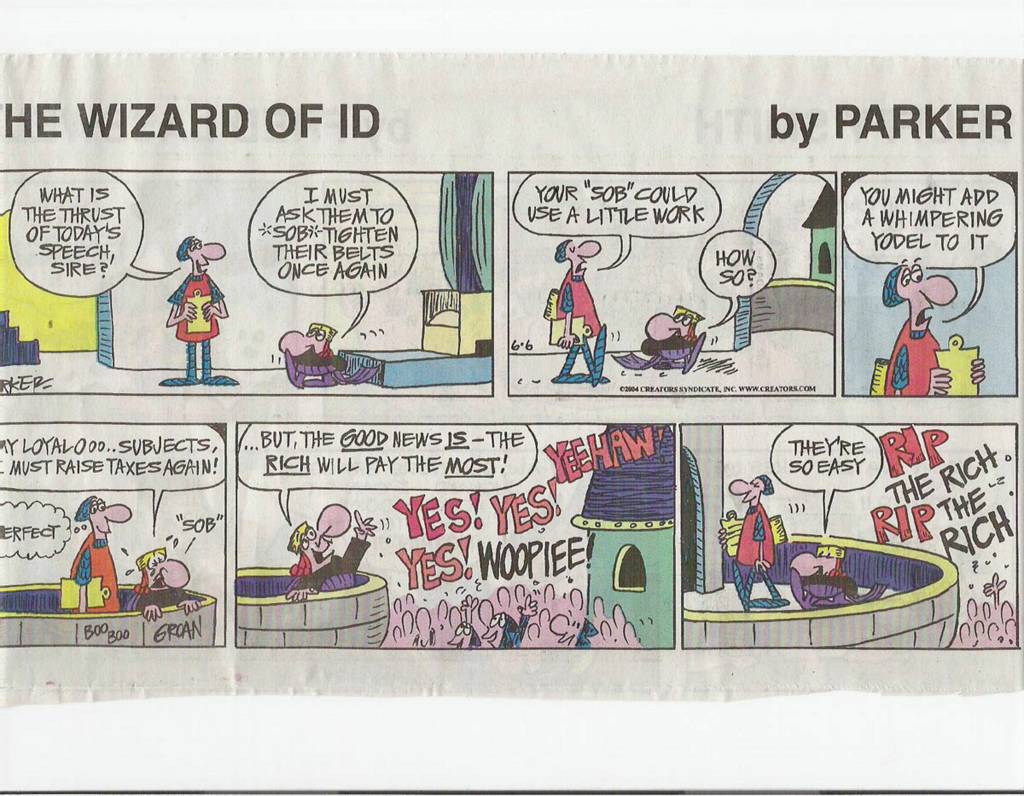
Bush just fought, and WON!, WW II. Again. Faster, and better!
It's really easy, if you will just believe.
Friendly Congregations
I found this hidden within an article on Trent Lott putting another foot in his mouth.
---
Anger Over Campaign's Call
Two religious watchdog groups cried foul yesterday over an e-mail from a Bush reelection staffer looking for churches and synagogues to serve as hubs for campaign activity in Pennsylvania.
"The Bush-Cheney '04 national headquarters in Virginia has asked us to identify 1600 'Friendly Congregations' in Pennsylvania where voters friendly to President Bush might gather on a regular basis," the e-mail said. "In each of these friendly congregations, we would like to identify a volunteer coordinator who can help distribute general information to other supporters."
The e-mail was forwarded to news organizations by the Interfaith Alliance and Americans United for Separation of Church and State. The Rev. Barry W. Lynn, executive director of Americans United, called it an effort to build "a church-based political machine" and said it could endanger the congregations' tax-exempt status, because IRS rules forbid churches from endorsing candidates or engaging in partisan campaigns.
Campaign spokesman Steve Schmidt said, "This e-mail is being sent to individual Bush supporters asking them to organize other volunteers within their faith community, and people of faith have as much right to participate in the political process as any other Americans."
---
Anger Over Campaign's Call
Two religious watchdog groups cried foul yesterday over an e-mail from a Bush reelection staffer looking for churches and synagogues to serve as hubs for campaign activity in Pennsylvania.
"The Bush-Cheney '04 national headquarters in Virginia has asked us to identify 1600 'Friendly Congregations' in Pennsylvania where voters friendly to President Bush might gather on a regular basis," the e-mail said. "In each of these friendly congregations, we would like to identify a volunteer coordinator who can help distribute general information to other supporters."
The e-mail was forwarded to news organizations by the Interfaith Alliance and Americans United for Separation of Church and State. The Rev. Barry W. Lynn, executive director of Americans United, called it an effort to build "a church-based political machine" and said it could endanger the congregations' tax-exempt status, because IRS rules forbid churches from endorsing candidates or engaging in partisan campaigns.
Campaign spokesman Steve Schmidt said, "This e-mail is being sent to individual Bush supporters asking them to organize other volunteers within their faith community, and people of faith have as much right to participate in the political process as any other Americans."
What did the president know and when did he know it?
Witnesses told a federal grand jury President George W. Bush knew about, and took no action to stop, the release of a covert CIA operative's name to a journalist in an attempt to discredit her husband, a critic of administration policy in Iraq.
Their damning testimony has prompted Bush to contact an outside lawyer for legal advice because evidence increasingly points to his involvement in the leak of covert CIA operative Valerie Plame's name to syndicated columnist Robert Novak.
Their damning testimony has prompted Bush to contact an outside lawyer for legal advice because evidence increasingly points to his involvement in the leak of covert CIA operative Valerie Plame's name to syndicated columnist Robert Novak.
Wednesday, June 02, 2004

Saturday, May 29, 2004
Monday, May 24, 2004
Why are gas prices rising?
Crude oil prices aren't the only reason...
...
It has become evident that stocks of product are the key variables that determine price
shocks. In other words, stocks are not only the key variable; they are also a strategic variable.
The industry does a miserable job of managing stocks and supplying product from the
consumer point of view. Policymakers have done nothing to force them to do a better job. If
the industry were vigorously competitive, each firm would have to worry a great deal more
about being caught with short supplies or inadequate capacity and they would hesitate to raise
prices for fear of losing sales to competitors. Oil companies do not behave this way because
they have power over price and can control supply. Mergers and acquisitions have created a
concentrated industry in several sections of the country and segments of the industry. The
amount of capacity and stocks and product on hand are no longer dictated by market forces,
they can be manipulated by the oil industry oligopoly to maximize profits.
...
Crude oil prices aren't the only reason...
...
It has become evident that stocks of product are the key variables that determine price
shocks. In other words, stocks are not only the key variable; they are also a strategic variable.
The industry does a miserable job of managing stocks and supplying product from the
consumer point of view. Policymakers have done nothing to force them to do a better job. If
the industry were vigorously competitive, each firm would have to worry a great deal more
about being caught with short supplies or inadequate capacity and they would hesitate to raise
prices for fear of losing sales to competitors. Oil companies do not behave this way because
they have power over price and can control supply. Mergers and acquisitions have created a
concentrated industry in several sections of the country and segments of the industry. The
amount of capacity and stocks and product on hand are no longer dictated by market forces,
they can be manipulated by the oil industry oligopoly to maximize profits.
...
Sunday, May 23, 2004
Israel has been warned.
They cannot say "Nobody told us, I didn't know, I heard rumors, but I didn't know. You were told. When you are tried in the courts, we will remember when and where you were told.
They cannot say "Nobody told us, I didn't know, I heard rumors, but I didn't know. You were told. When you are tried in the courts, we will remember when and where you were told.
Saturday, May 22, 2004
Friday, May 21, 2004
We are committed to the service of humanity, especially those who are economically and socially disadvantaged in our society.
Ours is a mission to do good for its own sake, without thought or expectation of reward or recognition, but with the hope of making a better world.
Ours is a mission to do good for its own sake, without thought or expectation of reward or recognition, but with the hope of making a better world.
This is too funny not to pass on...
According to a new report, the Bush Administration has taken its strong support for outsourcing further than previously thought -- opting to move key political operations offshore. India's Hindustan Times reports that, during a 14 month period from 2002 to 2003 when the Republican Party was playing up patriotism, its fund-raising and vote-seeking campaign was performed in part by two call centers located in India [1].
Source:
1. "Bush campaign ran from Noida call center", Hindustan Times, 05/16/2004,
http://daily.misleader.org/ctt.asp?u=1675067&l=36523.
According to a new report, the Bush Administration has taken its strong support for outsourcing further than previously thought -- opting to move key political operations offshore. India's Hindustan Times reports that, during a 14 month period from 2002 to 2003 when the Republican Party was playing up patriotism, its fund-raising and vote-seeking campaign was performed in part by two call centers located in India [1].
Source:
1. "Bush campaign ran from Noida call center", Hindustan Times, 05/16/2004,
http://daily.misleader.org/ctt.asp?u=1675067&l=36523.
More from the Howard Dean interview. This is great.
Q: People often ask me, "Will Bush give up power if he loses?" Do you have any fear that he would not go quietly?
HD: My biggest fear is that the election will be stolen again as it was in Florida by the elimination of large numbers of the African American community from the voter rolls by a private company contracting with the state. The election was clearly not won by George Bush in Florida, and then the Supreme Court put politics above loyalty to the country. So that's my greatest fear: not that George Bush won't go quietly according to the law, but that before the law gets enforced there will be a great deal of fiddling with it.
Q: What can be done to stop that?
HD: I've spoken to John Kerry about that, and he's going to have some legal teams in Florida. And I think we clearly have to deal with the voting machine issue: The Diebold voting machines have been undermined by their own chairman, who said he was going to do everything he could to get George Bush reelected. We've got to have legal advice, and we've got to have technical advice to make sure that those voting machines, which cannot be recounted, are used properly.
Q: People often ask me, "Will Bush give up power if he loses?" Do you have any fear that he would not go quietly?
HD: My biggest fear is that the election will be stolen again as it was in Florida by the elimination of large numbers of the African American community from the voter rolls by a private company contracting with the state. The election was clearly not won by George Bush in Florida, and then the Supreme Court put politics above loyalty to the country. So that's my greatest fear: not that George Bush won't go quietly according to the law, but that before the law gets enforced there will be a great deal of fiddling with it.
Q: What can be done to stop that?
HD: I've spoken to John Kerry about that, and he's going to have some legal teams in Florida. And I think we clearly have to deal with the voting machine issue: The Diebold voting machines have been undermined by their own chairman, who said he was going to do everything he could to get George Bush reelected. We've got to have legal advice, and we've got to have technical advice to make sure that those voting machines, which cannot be recounted, are used properly.
The StoryCorps! right here!!!
Ok, well, here...
AND there is audio blogging on blogger...
(see jerrysjournal.blogspot.com)
Storycorps AND audio blogging!
Ok, well, here...
AND there is audio blogging on blogger...
(see jerrysjournal.blogspot.com)
Storycorps AND audio blogging!
Check out the latest on-line ad of Kerry's. What do you think?
http://www.johnkerry.com/features/oil_house/
http://www.johnkerry.com/features/oil_house/
Thursday, May 20, 2004
Please note the mention of Bush near the end of the article.
Pathways to Peace
A Language of Love
Nonviolent Communication offers path to heart connection.
by Aria Seligmann
Dammit! You left dirty dishes in the sink again!
So wash them.
You wash them!
I'm doing something else right now.
I'm not your maid! (Storms out).
Scene sound familiar? Admit it; you know it does. Let's reframe the preceding argument, using Nonviolent Communication (NVC). Here's how you might think it would sound:
"I'm noticing the dishes in the sink and feeling overwhelmed and need a minute to just talk. Could you take a minute to talk to me about how we can do this dishes thing in a way that will work for all of us?"
You're closer, but that may be a trap to use to get someone else to do what you want them to do. Imagine adding to the sentence, "If these dishes don't somehow end up getting done, you're not getting your allowance," or there may be some other sort of punishment, such as a guilt trip, or rejection.
Nonviolent Communication, a process developed and refined over a period of 35 years by Dr. Marshall B. Rosenberg, provides a path to the deeper connection. Is our anger really about the dishes or do we want understanding about how our needs for cooperation, teamwork and support are not getting met? The outcome may not be getting the dishes done at that moment, but the need for understanding, for shared responsibility in the house, may become clear. The tension will dissolve, and the conflict will end.
Ending conflict is the life work of Rosenberg, who grew up in a turbulent Detroit neighborhood. The quest for understanding violence led to Rosenberg's studying and earning his doctorate in psychology. But traditional psychology did not satisfy his desire to understand how to resolve conflicts among people, whom he believed to be inherently nonviolent.
Rosenberg founded the Center for Nonviolent Communication in 1984, and has since traveled the world, holding NVC workshops and training others to do so. He is the author of Nonviolent Communication: A Language of Life and Life-Enriching Education. He has worked with individuals, couples, corporations and nations. Recently, he was in Israel and Palestine listening to the concerns of people there. He has also had significant influence in the field of restorative justice, bringing together perpetrators and their victims to help them achieve mutual understanding.
Rosenberg will be traveling through Oregon in early May, holding a series of workshops throughout the state. He'll hold two workshops in Eugene on May 7. Those workshops offer an opportunity for peace activists and others to get training in conflict resolution and to apply NVC on a personal level, as well.
NVC centers around observations, feelings, needs and requests. For example: "I'm observing there are dirty dishes in the sink. I have already washed all of mine. I would like to make dinner, and I'm unable to do so without a clean sink. I'm feeling frustrated and irritated, because I have a need for order, respect and support. Would you be willing to help with the dishes?"
By identifying our needs, which include basic needs such as food, shelter and water, interdependency needs such as understanding, trust, respect and support, or broader needs such as celebration, we can understand where anger, or any emotion, ultimately comes from. "All violence," says Rosenberg, "is the tragic expression of unmet needs."
In order to check in with what emotions we or others are feeling and why, NVC requires us to slow down, in our speech as well as reactive tendencies, and consciously become aware of what we are experiencing.
The techniques are not only suitable to interpersonal relationships, but apply to healing oneself, to working with contentious groups, such as gangs and police or labor and management, and ultimately can be used to resolve conflicts among nations.
One of the basic concepts of NVC is adopting a "power with" rather than "power over" structure. Rosenberg points to the domination structure humankind has been living under for the past 8,000 years. From the parent/child relationship to political forces, that structure defeats every human's basic need for autonomy. But how are we to undo what's been ingrained in us for so long?
Rosenberg, speaking from his home in Wasserfallenhof, Switzerland, says his approach is "radical." Beginning on the home front, he says, "get rid of the word 'child.' When I sometimes work with groups of parents I put half in one room and half in the other. Then we break down into smaller groups. We have a written role play of how they would communicate with someone who's borrowed something and hasn't returned it. One group is talking to a neighbor; the other to a child. The neighbor always gets more love and respect than the child."
Rosenberg says it's that very domination system that makes it "really hard to see a child as a neighbor."
That myopia can cut us off from connecting at a deeper level. Rosenberg recounts the time he came home from work, exhausted from having tried to mediate between street gangs and police in East St. Louis, Ill.
"It was very hard. I walked in the back door and my kids were fighting. I said in NVC, 'I need peace. Will you be willing to postpone this war?' My eldest son said, 'Do you want to talk about it?' I thought how cute. In doing so, I dehumanized him. I was doing the same thing the street gang and police were doing: not seeing human beings in each other. Here this human offers listening to me in distress. I have him labeled my child."
He accepted his son's offer of support, and says he "listened beautifully while I got out of my pain."
Using the word "child" is fine for shorthand, he says, but "don't see the person as a child, or especially, as my child. Extend the same respect to children as to a 40 year old."
The same "power with" model can be applied to the workplace, between management and labor. "In Switzerland, I coach people in the corporate area," says Rosenberg. "We're trained to tell managers to give praise and compliments every day, and research says productivity goes up. But it's only for a short time, until people sense the motivation behind it. That destroys trust in real gratitude."
People want ownership over their jobs, and the power with model usually results in greater satisfaction as each individual achieves greater autonomy.
Balancing that quest for autonomy with one's dependency needs is a dance. Rosenberg says, "We are interdependent; our well-being is one and the same. I can't benefit at your expense and you can't benefit at my expense." When people try to take advantage of others, or try to dominate them, violence occurs. From a child not wanting to go to bed to a nation striving for statehood, the needs are the same.
"A couple of days ago I was in Palestine," says Rosenberg. "The concerns of people there are all about autonomy. They don't want others telling them what to do. Every day, everywhere, there are fights going on regarding this. 'Please get ready for bed.' 'I don't want to.' It's about autonomy — we can tell from the child's tone of voice."
How we react to someone else's need for autonomy, which may come out as anger, is a matter of conscious choosing. By having empathy with the other and asking what they are feeling, we can help the anger dissolve. We can apply the same empathy to ourselves, in questioning what unmet need our feelings are resulting from. To do that, says Rosenberg, slow down and take your time.
He says, "My son was 12 and had done something I didn't like and I was telling myself to take my time so I could respond to him in a way that I liked. Meanwhile, his friends were waiting. He said, 'Daddy, it's taking you such a long time to talk.' I told him, 'Here's what I can say quickly: 'Do it my way or I'll kick your ass.' He waited."
Local NVC trainer and co-founder of the Oregon Network for Compassionate Communication (founded in September 2001 and sponsor of Rosenberg's visit), Michael Dreiling, a UO sociology professor, says NVC works by releasing people from criticism, blame and judgment, allowing them to connect with their own needs and those of others.
"Thoughts such as, 'Things would be better,' or 'I would be happier if you would have taken the trash out, or Bush would get out of office,' can deny our own responsibility and state of being," he says. "Instead, we can create alternative possibilities for meeting our own and others' needs. Criticism and blame can dehumanize the people we're connecting with, by holding them responsible for our anxiety, fear, hurt, pain, sadness, or anger, turning them into an object that is to be controlled or manipulated so we can be relieved of our pain."
NVC teaches that when we turn another human being into an object, "We've removed ourselves from the place of heart connection and having compassion for that human being and understanding why they might be doing what they're doing," says Dreiling. That objectification can also separate us from truly understanding our own needs and what Rosenberg says is "alive in us at that moment."
That consciousness is what gets us out of the reactive trap and allows for deeper connection and understanding to occur at a heart level. NVC also gets us out of the co-dependent trap. By checking in with our own feelings and needs first, we don't give ourselves away in the process of trying to understand the other. In fact, the final part of NVC, the request, allows us to say "No" — nonviolently. "No, I can't do the dishes right now, because I have a need for safety, and with you standing there raging at me, I don't feel safe. So I'm going to walk away and take 10 minutes and then I'll come back and we can talk about this."
In hearing that "no," says Dreiling, we can also hear a "yes."
For example, "Yes, I'm choosing to meet my own needs for safety, and yes, I am willing to resolve this matter, after my need for safety has been met."
Notice the non-dish-doer did not escalate the matter by yelling back, by calling names, "Quit yelling at me, you jerk," or increase the violence against himself by feeling guilty or allowing himself to be manipulated.
"The 'I'm feeling hurt and you're the cause' mentality, or 'You're feeling hurt and I'm bad because I'm the cause' mentality is so prevalent in our culture it is difficult to undo," says Dreiling. And it creates a cycle of violence, from domestic violence to community disputes to international warfare, that NVC can get us out of.
In fact, NVC reminds us that we have a deep need to nurture each other, to give, to care for others — what Rosenberg calls serving life.
"There's nothing more enjoyable or natural for we human beings than contributing to life and in seeing our power used for life," says Rosenberg. "It's not based on an abstract belief, but on the innate goodness of people. I've asked children or adults what you did that made somebody's life more wonderful. Now how did it feel when you realized you have that impact? I've asked in Africa, Asia, and the U.S.: Does anyone know anything that feels better?"
When we get beyond the image of the other as enemy, be it a family member, co-worker, neighbor or nation, and check in with what the other is needing, says Rosenberg, "Conflicts are resolved."
Pathways to Peace
A Language of Love
Nonviolent Communication offers path to heart connection.
by Aria Seligmann
Dammit! You left dirty dishes in the sink again!
So wash them.
You wash them!
I'm doing something else right now.
I'm not your maid! (Storms out).
Scene sound familiar? Admit it; you know it does. Let's reframe the preceding argument, using Nonviolent Communication (NVC). Here's how you might think it would sound:
"I'm noticing the dishes in the sink and feeling overwhelmed and need a minute to just talk. Could you take a minute to talk to me about how we can do this dishes thing in a way that will work for all of us?"
You're closer, but that may be a trap to use to get someone else to do what you want them to do. Imagine adding to the sentence, "If these dishes don't somehow end up getting done, you're not getting your allowance," or there may be some other sort of punishment, such as a guilt trip, or rejection.
Nonviolent Communication, a process developed and refined over a period of 35 years by Dr. Marshall B. Rosenberg, provides a path to the deeper connection. Is our anger really about the dishes or do we want understanding about how our needs for cooperation, teamwork and support are not getting met? The outcome may not be getting the dishes done at that moment, but the need for understanding, for shared responsibility in the house, may become clear. The tension will dissolve, and the conflict will end.
Ending conflict is the life work of Rosenberg, who grew up in a turbulent Detroit neighborhood. The quest for understanding violence led to Rosenberg's studying and earning his doctorate in psychology. But traditional psychology did not satisfy his desire to understand how to resolve conflicts among people, whom he believed to be inherently nonviolent.
Rosenberg founded the Center for Nonviolent Communication in 1984, and has since traveled the world, holding NVC workshops and training others to do so. He is the author of Nonviolent Communication: A Language of Life and Life-Enriching Education. He has worked with individuals, couples, corporations and nations. Recently, he was in Israel and Palestine listening to the concerns of people there. He has also had significant influence in the field of restorative justice, bringing together perpetrators and their victims to help them achieve mutual understanding.
Rosenberg will be traveling through Oregon in early May, holding a series of workshops throughout the state. He'll hold two workshops in Eugene on May 7. Those workshops offer an opportunity for peace activists and others to get training in conflict resolution and to apply NVC on a personal level, as well.
NVC centers around observations, feelings, needs and requests. For example: "I'm observing there are dirty dishes in the sink. I have already washed all of mine. I would like to make dinner, and I'm unable to do so without a clean sink. I'm feeling frustrated and irritated, because I have a need for order, respect and support. Would you be willing to help with the dishes?"
By identifying our needs, which include basic needs such as food, shelter and water, interdependency needs such as understanding, trust, respect and support, or broader needs such as celebration, we can understand where anger, or any emotion, ultimately comes from. "All violence," says Rosenberg, "is the tragic expression of unmet needs."
In order to check in with what emotions we or others are feeling and why, NVC requires us to slow down, in our speech as well as reactive tendencies, and consciously become aware of what we are experiencing.
The techniques are not only suitable to interpersonal relationships, but apply to healing oneself, to working with contentious groups, such as gangs and police or labor and management, and ultimately can be used to resolve conflicts among nations.
One of the basic concepts of NVC is adopting a "power with" rather than "power over" structure. Rosenberg points to the domination structure humankind has been living under for the past 8,000 years. From the parent/child relationship to political forces, that structure defeats every human's basic need for autonomy. But how are we to undo what's been ingrained in us for so long?
Rosenberg, speaking from his home in Wasserfallenhof, Switzerland, says his approach is "radical." Beginning on the home front, he says, "get rid of the word 'child.' When I sometimes work with groups of parents I put half in one room and half in the other. Then we break down into smaller groups. We have a written role play of how they would communicate with someone who's borrowed something and hasn't returned it. One group is talking to a neighbor; the other to a child. The neighbor always gets more love and respect than the child."
Rosenberg says it's that very domination system that makes it "really hard to see a child as a neighbor."
That myopia can cut us off from connecting at a deeper level. Rosenberg recounts the time he came home from work, exhausted from having tried to mediate between street gangs and police in East St. Louis, Ill.
"It was very hard. I walked in the back door and my kids were fighting. I said in NVC, 'I need peace. Will you be willing to postpone this war?' My eldest son said, 'Do you want to talk about it?' I thought how cute. In doing so, I dehumanized him. I was doing the same thing the street gang and police were doing: not seeing human beings in each other. Here this human offers listening to me in distress. I have him labeled my child."
He accepted his son's offer of support, and says he "listened beautifully while I got out of my pain."
Using the word "child" is fine for shorthand, he says, but "don't see the person as a child, or especially, as my child. Extend the same respect to children as to a 40 year old."
The same "power with" model can be applied to the workplace, between management and labor. "In Switzerland, I coach people in the corporate area," says Rosenberg. "We're trained to tell managers to give praise and compliments every day, and research says productivity goes up. But it's only for a short time, until people sense the motivation behind it. That destroys trust in real gratitude."
People want ownership over their jobs, and the power with model usually results in greater satisfaction as each individual achieves greater autonomy.
Balancing that quest for autonomy with one's dependency needs is a dance. Rosenberg says, "We are interdependent; our well-being is one and the same. I can't benefit at your expense and you can't benefit at my expense." When people try to take advantage of others, or try to dominate them, violence occurs. From a child not wanting to go to bed to a nation striving for statehood, the needs are the same.
"A couple of days ago I was in Palestine," says Rosenberg. "The concerns of people there are all about autonomy. They don't want others telling them what to do. Every day, everywhere, there are fights going on regarding this. 'Please get ready for bed.' 'I don't want to.' It's about autonomy — we can tell from the child's tone of voice."
How we react to someone else's need for autonomy, which may come out as anger, is a matter of conscious choosing. By having empathy with the other and asking what they are feeling, we can help the anger dissolve. We can apply the same empathy to ourselves, in questioning what unmet need our feelings are resulting from. To do that, says Rosenberg, slow down and take your time.
He says, "My son was 12 and had done something I didn't like and I was telling myself to take my time so I could respond to him in a way that I liked. Meanwhile, his friends were waiting. He said, 'Daddy, it's taking you such a long time to talk.' I told him, 'Here's what I can say quickly: 'Do it my way or I'll kick your ass.' He waited."
Local NVC trainer and co-founder of the Oregon Network for Compassionate Communication (founded in September 2001 and sponsor of Rosenberg's visit), Michael Dreiling, a UO sociology professor, says NVC works by releasing people from criticism, blame and judgment, allowing them to connect with their own needs and those of others.
"Thoughts such as, 'Things would be better,' or 'I would be happier if you would have taken the trash out, or Bush would get out of office,' can deny our own responsibility and state of being," he says. "Instead, we can create alternative possibilities for meeting our own and others' needs. Criticism and blame can dehumanize the people we're connecting with, by holding them responsible for our anxiety, fear, hurt, pain, sadness, or anger, turning them into an object that is to be controlled or manipulated so we can be relieved of our pain."
NVC teaches that when we turn another human being into an object, "We've removed ourselves from the place of heart connection and having compassion for that human being and understanding why they might be doing what they're doing," says Dreiling. That objectification can also separate us from truly understanding our own needs and what Rosenberg says is "alive in us at that moment."
That consciousness is what gets us out of the reactive trap and allows for deeper connection and understanding to occur at a heart level. NVC also gets us out of the co-dependent trap. By checking in with our own feelings and needs first, we don't give ourselves away in the process of trying to understand the other. In fact, the final part of NVC, the request, allows us to say "No" — nonviolently. "No, I can't do the dishes right now, because I have a need for safety, and with you standing there raging at me, I don't feel safe. So I'm going to walk away and take 10 minutes and then I'll come back and we can talk about this."
In hearing that "no," says Dreiling, we can also hear a "yes."
For example, "Yes, I'm choosing to meet my own needs for safety, and yes, I am willing to resolve this matter, after my need for safety has been met."
Notice the non-dish-doer did not escalate the matter by yelling back, by calling names, "Quit yelling at me, you jerk," or increase the violence against himself by feeling guilty or allowing himself to be manipulated.
"The 'I'm feeling hurt and you're the cause' mentality, or 'You're feeling hurt and I'm bad because I'm the cause' mentality is so prevalent in our culture it is difficult to undo," says Dreiling. And it creates a cycle of violence, from domestic violence to community disputes to international warfare, that NVC can get us out of.
In fact, NVC reminds us that we have a deep need to nurture each other, to give, to care for others — what Rosenberg calls serving life.
"There's nothing more enjoyable or natural for we human beings than contributing to life and in seeing our power used for life," says Rosenberg. "It's not based on an abstract belief, but on the innate goodness of people. I've asked children or adults what you did that made somebody's life more wonderful. Now how did it feel when you realized you have that impact? I've asked in Africa, Asia, and the U.S.: Does anyone know anything that feels better?"
When we get beyond the image of the other as enemy, be it a family member, co-worker, neighbor or nation, and check in with what the other is needing, says Rosenberg, "Conflicts are resolved."
===============================
THE DAILY MIS-LEAD
< http://daily.misleader.org/ctt.asp?u=1675067&l=36308 > ===============================
STONEWALLING ON BIN LADEN/SAUDI FLIGHTS AFTER 9/11
With questions swirling about who authorized allowing relatives of Osama bin Laden to fly out of the country immediately after 9/11, The Hill newspaper is reporting that President Bush is "refusing to answer repeated requests by the September 11 commission" about the matter [1].
Last year, Secretary of State Colin Powell acknowledged that, even as all foreign and domestic flights were grounded after 9/11, the bin Ladens and other wealthy Saudis were allowed to fly out of the United States. He said that "the flights were well-known and it was coordinated within the government" [2].
Yet now, even as White House officials claim that "the [P]resident has fully cooperated with this commission in an unprecedented way" [3], the panel vice chairman Lee Hamilton disclosed that the Administration is refusing to answer any questions on the subject -- even in closed-door meetings with Senators [4]. The President is also still refusing to release 28 pages of the bipartisan 9/11 congressional report about the Saudi Government. That report is known to "depict a Saudi government that not only provided significant money and aid to the suicide hijackers but also allowed potentially hundreds of millions of dollars to flow to Al Qaeda" [5]. Some of that money may have even flowed through Riggs Bank [6], where the President's uncle [7] (and major fundraiser [8]) is a top executive. Nonetheless, the President continues to refer to the Saudi government as "our friend" [9].
Sources:
1. "Who let bin Ladens leave U.S.?", The Hill, 05/18/2004,
http://daily.misleader.org/ctt.asp?u=1675067&l=36309.
2. Interview on NBC's Meet the Press With Tim Russert, 09/07/2003,
http://daily.misleader.org/ctt.asp?u=1675067&l=36310.
3. Meet The Press transcript, 04/04/2004, http://daily.misleader.org/ctt.asp?u=1675067&l=36311.
4. "Who let bin Ladens leave U.S.?", The Hill, 05/18/2004,
http://daily.misleader.org/ctt.asp?u=1675067&l=36309.
5. "Saudi Government Provided Aid to 9/11 Hijackers, Sources Say", Los
Angeles Times, 08/02/2003, http://daily.misleader.org/ctt.asp?u=1675067&l=36312.
6. Riggs Press Release, 05/31/2000,
http://daily.misleader.org/ctt.asp?u=1675067&l=36313.
7. Riggs Press Release, 05/31/2000,
http://daily.misleader.org/ctt.asp?u=1675067&l=36313.
8. Texans for Public Justice,
http://daily.misleader.org/ctt.asp?u=1675067&l=36314.
9. President Bush Vows to Bring Terrorists to Justice, 05/16/2003,
http://daily.misleader.org/ctt.asp?u=1675067&l=36315.
THE DAILY MIS-LEAD
< http://daily.misleader.org/ctt.asp?u=1675067&l=36308 > ===============================
STONEWALLING ON BIN LADEN/SAUDI FLIGHTS AFTER 9/11
With questions swirling about who authorized allowing relatives of Osama bin Laden to fly out of the country immediately after 9/11, The Hill newspaper is reporting that President Bush is "refusing to answer repeated requests by the September 11 commission" about the matter [1].
Last year, Secretary of State Colin Powell acknowledged that, even as all foreign and domestic flights were grounded after 9/11, the bin Ladens and other wealthy Saudis were allowed to fly out of the United States. He said that "the flights were well-known and it was coordinated within the government" [2].
Yet now, even as White House officials claim that "the [P]resident has fully cooperated with this commission in an unprecedented way" [3], the panel vice chairman Lee Hamilton disclosed that the Administration is refusing to answer any questions on the subject -- even in closed-door meetings with Senators [4]. The President is also still refusing to release 28 pages of the bipartisan 9/11 congressional report about the Saudi Government. That report is known to "depict a Saudi government that not only provided significant money and aid to the suicide hijackers but also allowed potentially hundreds of millions of dollars to flow to Al Qaeda" [5]. Some of that money may have even flowed through Riggs Bank [6], where the President's uncle [7] (and major fundraiser [8]) is a top executive. Nonetheless, the President continues to refer to the Saudi government as "our friend" [9].
Sources:
1. "Who let bin Ladens leave U.S.?", The Hill, 05/18/2004,
http://daily.misleader.org/ctt.asp?u=1675067&l=36309.
2. Interview on NBC's Meet the Press With Tim Russert, 09/07/2003,
http://daily.misleader.org/ctt.asp?u=1675067&l=36310.
3. Meet The Press transcript, 04/04/2004, http://daily.misleader.org/ctt.asp?u=1675067&l=36311.
4. "Who let bin Ladens leave U.S.?", The Hill, 05/18/2004,
http://daily.misleader.org/ctt.asp?u=1675067&l=36309.
5. "Saudi Government Provided Aid to 9/11 Hijackers, Sources Say", Los
Angeles Times, 08/02/2003, http://daily.misleader.org/ctt.asp?u=1675067&l=36312.
6. Riggs Press Release, 05/31/2000,
http://daily.misleader.org/ctt.asp?u=1675067&l=36313.
7. Riggs Press Release, 05/31/2000,
http://daily.misleader.org/ctt.asp?u=1675067&l=36313.
8. Texans for Public Justice,
http://daily.misleader.org/ctt.asp?u=1675067&l=36314.
9. President Bush Vows to Bring Terrorists to Justice, 05/16/2003,
http://daily.misleader.org/ctt.asp?u=1675067&l=36315.
Wednesday, May 19, 2004
The election IS lost.
more...
As to Nader having moral integrity, that is ludicrous! Nader's flaws are legion: how about just one: the end justifies the means.
If you have not come here to die, you must be lost, for you are in the wrong place...
more...
As to Nader having moral integrity, that is ludicrous! Nader's flaws are legion: how about just one: the end justifies the means.
If you have not come here to die, you must be lost, for you are in the wrong place...
Tuesday, May 18, 2004

Should cowboy Bush ride into the sunset?
As a former combat infantryman in World War II, I've always believed we must fully support our troops. Reluctantly, I now believe the best way to support troops in Iraq is to bring them home, starting with the "hand-over" on June 30.
Only a carefully planned withdrawal can clean up the biggest military mess miscreated in the Oval Office and miscarried by the Pentagon in my 80-year lifetime. In Journalese, the traditional five Ws of Who, What, When, Where, Why:
Who? George W. Bush.
What? His cowboy culture. Ride fast and alone or with just a few buddies. Shoot first. Ask questions later.
When? After 9/11. Bush bravely took on a necessary fight against terrorists who attacked us. But then he diverted his attention to an unrelated and unnecessary "pre-emptive" war.
Where? Iraq. He led us astray by falsely claiming Saddam Hussein had weapons of mass destruction that threatened us. After the "Mission Accomplished" boast in May 2003, he put our troops in new jeopardy by taunting terrorists from other countries with his "Bring 'em on!" challenge last July 2. His anything-goes-against-the-bad-guys attitude and his total lack of postwar planning helped prompt the ongoing prison-abuse embarrassments and brutal retaliations.
Why? Because he believes he can be re-elected as a tough-talking, self-proclaimed "War President."
Maybe Bush should take a cue from a fellow Texan, former president Lyndon Baines Johnson, who also had some cowboy characteristics.
LBJ, after mismanaging the Vietnam War that so bitterly divided the nation and the world, decided he owed it to his political party and to his country not to run for re-election. So, he turned tail and rode off into the sunset of his Texas ranch.
How do you say déjà vu in Cowboyese?
Monday, May 17, 2004
US guards 'filmed beatings' at terror camp
Senator urges action as Briton reveals Guantanamo abuse
David Rose and Gaby Hinsliff
Sunday May 16, 2004
The Observer
Dozens of videotapes of American guards allegedly engaged in brutal attacks on Guantanamo Bay detainees have been stored and catalogued at the camp, an investigation by The Observer has revealed.
More...
Senator urges action as Briton reveals Guantanamo abuse
David Rose and Gaby Hinsliff
Sunday May 16, 2004
The Observer
Dozens of videotapes of American guards allegedly engaged in brutal attacks on Guantanamo Bay detainees have been stored and catalogued at the camp, an investigation by The Observer has revealed.
More...
White House 'tried to block film'
The White House tried to halt the making and release of Michael Moore's new film Fahrenheit 9/11, the film-maker alleged in Cannes on Sunday.
The director told a Cannes audience the Bush administration wanted to keep the film off screens in the run-up to November's US election.
The film examines the Iraq war and alleges connections between the Bush and Bin Laden families.
Fahrenheit 9/11 is to get its world premiere in Cannes on Monday.
Film studio Disney had backed out of a deal to distribute the film in the US for political reasons, Moore says.
He has given no evidence to substantiate his allegations, but said "someone connected to the White House" and a "top Republican" had put pressure on film companies not to release the film.
Moore said the few who had seen the film had told him "the potential for this film to have an impact on the election was much larger than they thought".
Undercover in Iraq
The film was originally scheduled to be released through Disney-backed independent studio Miramax, before Disney blocked it.
It is now expected to be released through a third party.
Disney accused Moore of engineering a dispute about the film's release to gain maximum publicity. It said it had blocked the film because it wanted to be impartial during the election, but strongly denied coming under any outside pressure.
The director has already shown the film at test screenings in the Midwest of the US.
"The reaction was overwhelming," he said. "People who were on the fence - undecided voters - suddenly weren't on the fence."
No-one from the White House was available to comment on his remarks.
Moore has also revealed that he had three undercover film crews embedded with US troops in Iraq.
"I was able to sneak three different freelance crews into Iraq," he said on Saturday.
The soldiers had "expressed disillusionment that they had been lied to", said Moore.
The film from Iraq was a "very important" part of the documentary, he added.
"It is certainly something the Bush administration does not want people to see," said Moore.
The White House tried to halt the making and release of Michael Moore's new film Fahrenheit 9/11, the film-maker alleged in Cannes on Sunday.
The director told a Cannes audience the Bush administration wanted to keep the film off screens in the run-up to November's US election.
The film examines the Iraq war and alleges connections between the Bush and Bin Laden families.
Fahrenheit 9/11 is to get its world premiere in Cannes on Monday.
Film studio Disney had backed out of a deal to distribute the film in the US for political reasons, Moore says.
He has given no evidence to substantiate his allegations, but said "someone connected to the White House" and a "top Republican" had put pressure on film companies not to release the film.
Moore said the few who had seen the film had told him "the potential for this film to have an impact on the election was much larger than they thought".
Undercover in Iraq
The film was originally scheduled to be released through Disney-backed independent studio Miramax, before Disney blocked it.
It is now expected to be released through a third party.
Disney accused Moore of engineering a dispute about the film's release to gain maximum publicity. It said it had blocked the film because it wanted to be impartial during the election, but strongly denied coming under any outside pressure.
The director has already shown the film at test screenings in the Midwest of the US.
"The reaction was overwhelming," he said. "People who were on the fence - undecided voters - suddenly weren't on the fence."
No-one from the White House was available to comment on his remarks.
Moore has also revealed that he had three undercover film crews embedded with US troops in Iraq.
"I was able to sneak three different freelance crews into Iraq," he said on Saturday.
The soldiers had "expressed disillusionment that they had been lied to", said Moore.
The film from Iraq was a "very important" part of the documentary, he added.
"It is certainly something the Bush administration does not want people to see," said Moore.
Sunday, May 16, 2004
When the administration denies something as passionately as this, we can only assume it is true.
The New York Times > International > Middle East > Article Saying Rumsfeld Backed Harsh Tactics Stirs Controversy
CHAIN OF COMMAND
How the Department of Defense mishandled the disaster at Abu Ghraib.
by SEYMOUR M. HERSH "Soon after 9/11, as the war on terror got under way, Donald Rumsfeld repeatedly made public his disdain for the Geneva conventions. Complaints about America’s treatment of prisoners, Rumsfeld said in early 2002, amounted to “isolated pockets of international hyperventilation.”"
The New York Times > International > Middle East > Article Saying Rumsfeld Backed Harsh Tactics Stirs Controversy
CHAIN OF COMMAND
How the Department of Defense mishandled the disaster at Abu Ghraib.
by SEYMOUR M. HERSH "Soon after 9/11, as the war on terror got under way, Donald Rumsfeld repeatedly made public his disdain for the Geneva conventions. Complaints about America’s treatment of prisoners, Rumsfeld said in early 2002, amounted to “isolated pockets of international hyperventilation.”"
Saturday, May 15, 2004
Our country was founded on secular ideals. The rise of the fundamentalists (American Taliban?) within our political system is rapidly eroding the principles that have made our nation's political and justice system stand out as unique in the world. These days, being known as "too secular" means you are unelectable. Thomas Jefferson would be unelectable if he were alive today.
beliefnet: Excerpt from 'Freethinkers' by Susan Jacoby "It is difficult, in an era in which most Americans acquire their information from packaged sound bites that require almost no effort from audiences, to convey the excitement of a time when people were willing to expend a good deal of energy looking at evidence, and listening to opinions, that challenged the received wisdom of previous ages."
Progressive News - Our Secular Nation by Susan Jacoby: "In fact�and it is a little-known fact today�devout evangelical Christians were among the strongest supporters of the separation between church and state that took shape in the formative years of the republic."
Jefferson's Wall of Separation Letter - The U.S. Constitution Online - USConstitution.net "Believing with you that religion is a matter which lies solely between man & his god, that he owes account to none other for his faith or his worship, that the legitimate powers of government reach actions only, and not opinions, I contemplate with sovereign reverence that act of the whole American people which declared that their legislature should make no law respecting an establishment of religion, or prohibiting the free exercise thereof, thus building a wall of separation between church and state"
NOW with Bill Moyers. Politics & Economy. God and Government. Separating Church and State | PBS
beliefnet: Excerpt from 'Freethinkers' by Susan Jacoby "It is difficult, in an era in which most Americans acquire their information from packaged sound bites that require almost no effort from audiences, to convey the excitement of a time when people were willing to expend a good deal of energy looking at evidence, and listening to opinions, that challenged the received wisdom of previous ages."
Progressive News - Our Secular Nation by Susan Jacoby: "In fact�and it is a little-known fact today�devout evangelical Christians were among the strongest supporters of the separation between church and state that took shape in the formative years of the republic."
Jefferson's Wall of Separation Letter - The U.S. Constitution Online - USConstitution.net "Believing with you that religion is a matter which lies solely between man & his god, that he owes account to none other for his faith or his worship, that the legitimate powers of government reach actions only, and not opinions, I contemplate with sovereign reverence that act of the whole American people which declared that their legislature should make no law respecting an establishment of religion, or prohibiting the free exercise thereof, thus building a wall of separation between church and state"
NOW with Bill Moyers. Politics & Economy. God and Government. Separating Church and State | PBS
Friday, May 14, 2004


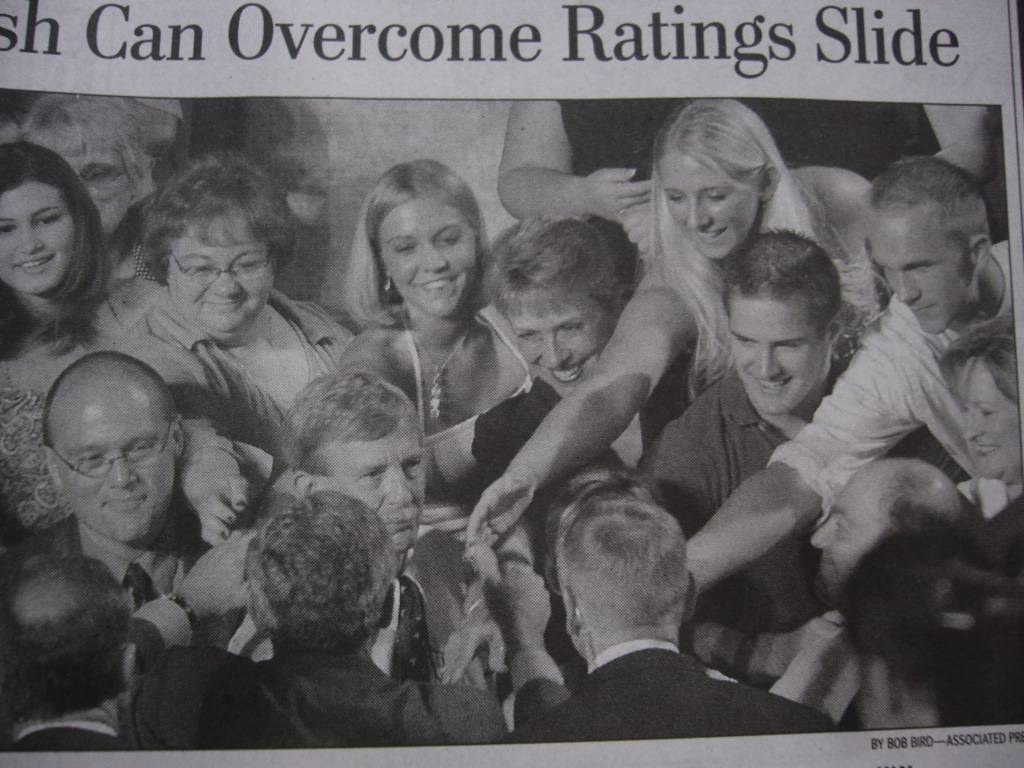
Beheading Victim 'Loved Adventure and Risk'
By Sewell Chan
Washington Post Foreign Service
Friday, May 14, 2004; Page A01
he found it
Let's be fair: there are lots of nice people who get killed. I think some of them are Iraqies. And some Americans and their corporations are carpetbagging opportunists. And getting your head chopped off vs fried in an American electric chair or being on death row for 15 years when you are not guilty or when you are just generally fucked for being black... ah, but don't get me started.
Berg was clearly exceptional: and there was work to be done at home.
By Sewell Chan
Washington Post Foreign Service
Friday, May 14, 2004; Page A01
he found it
Let's be fair: there are lots of nice people who get killed. I think some of them are Iraqies. And some Americans and their corporations are carpetbagging opportunists. And getting your head chopped off vs fried in an American electric chair or being on death row for 15 years when you are not guilty or when you are just generally fucked for being black... ah, but don't get me started.
Berg was clearly exceptional: and there was work to be done at home.
Thursday, May 13, 2004
Wednesday, May 12, 2004
Since it is nearly imposible to keep tabs on the number of wounded men and women of our military in Iraq by reading the news, I post here an update and a link.
The Wounded: US Military as reported after 4/3
Period Wnd-RTD Wounded
19-Mar-03 thru 03-Apr-03 115 426
04-Apr-03 thru 02-Apr-04 963 1484
03-Apr-04 thru 09-Apr-04 59 222
10-Apr-04 thru 16-Apr-04 119 242
17-Apr-04 thru 23-Apr-04 138 96
24-Apr-04 thru 03-May-04 193 76
04-May-04 thru 11-May-04 82 116
Total 1669 2662
Wnd-RTD: Wounded in Action Return to Duty within 72 hours
Wnd: Wounded in Action Not Return to Duty within 72 hours
The Wounded: US Military as reported after 4/3
Period Wnd-RTD Wounded
19-Mar-03 thru 03-Apr-03 115 426
04-Apr-03 thru 02-Apr-04 963 1484
03-Apr-04 thru 09-Apr-04 59 222
10-Apr-04 thru 16-Apr-04 119 242
17-Apr-04 thru 23-Apr-04 138 96
24-Apr-04 thru 03-May-04 193 76
04-May-04 thru 11-May-04 82 116
Total 1669 2662
Wnd-RTD: Wounded in Action Return to Duty within 72 hours
Wnd: Wounded in Action Not Return to Duty within 72 hours
Tuesday, May 11, 2004

Letters to the Editor from today's NYTimes
To the Editor:
Defense Secretary Donald H. Rumsfeld's declaration that the United States supports the rule of law was gratifying (excerpts from the Congressional hearing, May 8). It might have been more convincing if we had not repudiated the International Criminal Court and continued to pressure other countries into guaranteeing that no American would ever be sent to The Hague for war crimes or crimes against humanity.
Credibility suffers when we approve international law, but only for others.
BENJAMIN B. FERENCZ
New Rochelle, N.Y., May 8, 2004
The writer was a prosecutor at the Nuremberg war crimes trials.
•
To the Editor:
Once again, David Brooks steadfastly approves of a demonstrably failed foreign policy ("Crisis of Confidence," column, May 8). "We've got to reboot," he writes.
Although an amusing metaphor, rebooting foreign policy implies that the policy is essentially sound, with only an operational glitch.
This administration's foreign policy is not computer software; it is dead and wounded American soldiers and civilians, uncounted Iraqi casualties, collapsed international credibility and now, with Abu Ghraib, destruction of American moral values that will not be recovered in the lifetimes of my great-grandchildren.
My father and oldest brother were graduates of West Point. Dad served in World War II. My oldest brother served three tours in Vietnam. Another brother served in the Navy for six years. I served in the Army Reserve. My sons served in Desert Storm. My youngest son is in Afghanistan as I write.
There is no excuse for what just happened.
WILLIAM A. FERRY
Lafayette, La., May 8, 2004
•
To the Editor:
David Brooks has it almost right in his analysis of our current national crisis (column, May 8). But when he asserts, "It was U.S. inaction against Al Qaeda that got us into this mess in the first place," he has it all wrong.
What got us into this mess was the unnecessary invasion of Iraq, which played perfectly into the plans of Osama bin Laden.
It has subverted the war against terrorism by diverting military and financial resources and political attention away from that war and directing them toward fighting Saddam Hussein, who, as a secular ruler, was one of Osama bin Laden's main enemies.
It has also produced the greatest boon to recruitment for Al Qaeda worldwide.
Thus it has made us less safe, financially strapped and isolated from the world community.
OWEN C. THOMAS
Berkeley, Calif., May 8, 2004
To the Editor:
Defense Secretary Donald H. Rumsfeld's declaration that the United States supports the rule of law was gratifying (excerpts from the Congressional hearing, May 8). It might have been more convincing if we had not repudiated the International Criminal Court and continued to pressure other countries into guaranteeing that no American would ever be sent to The Hague for war crimes or crimes against humanity.
Credibility suffers when we approve international law, but only for others.
BENJAMIN B. FERENCZ
New Rochelle, N.Y., May 8, 2004
The writer was a prosecutor at the Nuremberg war crimes trials.
•
To the Editor:
Once again, David Brooks steadfastly approves of a demonstrably failed foreign policy ("Crisis of Confidence," column, May 8). "We've got to reboot," he writes.
Although an amusing metaphor, rebooting foreign policy implies that the policy is essentially sound, with only an operational glitch.
This administration's foreign policy is not computer software; it is dead and wounded American soldiers and civilians, uncounted Iraqi casualties, collapsed international credibility and now, with Abu Ghraib, destruction of American moral values that will not be recovered in the lifetimes of my great-grandchildren.
My father and oldest brother were graduates of West Point. Dad served in World War II. My oldest brother served three tours in Vietnam. Another brother served in the Navy for six years. I served in the Army Reserve. My sons served in Desert Storm. My youngest son is in Afghanistan as I write.
There is no excuse for what just happened.
WILLIAM A. FERRY
Lafayette, La., May 8, 2004
•
To the Editor:
David Brooks has it almost right in his analysis of our current national crisis (column, May 8). But when he asserts, "It was U.S. inaction against Al Qaeda that got us into this mess in the first place," he has it all wrong.
What got us into this mess was the unnecessary invasion of Iraq, which played perfectly into the plans of Osama bin Laden.
It has subverted the war against terrorism by diverting military and financial resources and political attention away from that war and directing them toward fighting Saddam Hussein, who, as a secular ruler, was one of Osama bin Laden's main enemies.
It has also produced the greatest boon to recruitment for Al Qaeda worldwide.
Thus it has made us less safe, financially strapped and isolated from the world community.
OWEN C. THOMAS
Berkeley, Calif., May 8, 2004
From the conservative David Brooks
For Iraqis to Win, the U.S. Must Lose
This has been a crushingly depressing period, especially for people who support the war in Iraq. The predictions people on my side made about the postwar world have not yet come true. The warnings others made about the fractious state of post-Saddam society have.
It's still too soon to declare the Iraq mission a failure. Some of the best reporting out of Iraq suggests that many Iraqis have stared into the abyss of what their country could become and have decided to work with renewed vigor toward the democracy that both we and they want.
Nonetheless, it's not too early to begin thinking about what was clearly an intellectual failure. There was, above all, a failure to understand the consequences of our power. There was a failure to anticipate the response our power would have on the people we sought to liberate. They resent us for our power and at the same time expect us to be capable of everything. There was a failure to understand the effect our power would have on other people around the world. We were so sure we were using our might for noble purposes, we assumed that sooner or later, everybody else would see that as well. Far from being blinded by greed, we were blinded by idealism.
Just after World War II, there were Americans who were astute students of the nature and consequences of American power. America's midcentury leaders — politicians like F.D.R. and Harry Truman, as well as public intellectuals like Reinhold Niebuhr and James Burnham — had seen American might liberate death camps. They had also seen Americans commit wartime atrocities that surpass those at Abu Ghraib.
These midcentury leaders were idealists, but they were rugged idealists, because they combined a cold-eyed view of reality with a warm self-confidence in their ability to do history-changing good.
They took a tragically ironic view of their situation. They understood that we can't defeat ruthless enemies without wielding power. But we can't wield power without sometimes being corrupted by it. Therefore, we can't do good without losing our innocence.
History had assigned them a dirty job: taking morally hazardous action. They did not try to escape, but they did not expect sainthood.
That rugged idealism looks appealing today. We went into Iraq with what, in retrospect, seems like a childish fantasy. We were going to topple Saddam, establish democracy and hand the country back to grateful Iraqis. We expected to be universally admired when it was all over.
We didn't understand the tragic irony that our power is also our weakness. As long as we seemed so mighty, others, even those we were aiming to assist, were bound to revolt. They would do so for their own self-respect. In taking out Saddam, we robbed the Iraqis of the honor of liberating themselves. The fact that they had no means to do so is beside the point.
Now, looking ahead, we face another irony. To earn their own freedom, the Iraqis need a victory. And since it is too late for the Iraqis to have a victory over Saddam, it is imperative that they have a victory over us. If the future textbooks of a free Iraq get written, the toppling of Saddam will be vaguely mentioned in one clause in one sentence. But the heroic Iraqi resistance against the American occupation will be lavishly described, page after page. For us to succeed in Iraq, we have to lose.
That means the good Iraqis, the ones who support democracy, have to have a forum in which they can defy us. If the insurgents are the only anti-Americans, then there will always be a soft spot for them in the hearts of Iraqi patriots.
That forum is an election campaign. There would be significant risks involved in moving the Iraq elections up to this fall. Parties might use their militias to coerce votes. But Iraqis have to see their candidates and themselves standing up with speeches and ideas, not just with R.P.G.'s. The insurgency would come to look anti-democratic, which would be seen to be bad, not just anti-American, which is seen to be good.
If the Iraqis do campaign this fall, then at their rallies they will jeer at us. We will still be hated around the world. But we will have succeeded in doing what we set out to do.
And we will have learned about the irony of our situation.
For Iraqis to Win, the U.S. Must Lose
This has been a crushingly depressing period, especially for people who support the war in Iraq. The predictions people on my side made about the postwar world have not yet come true. The warnings others made about the fractious state of post-Saddam society have.
It's still too soon to declare the Iraq mission a failure. Some of the best reporting out of Iraq suggests that many Iraqis have stared into the abyss of what their country could become and have decided to work with renewed vigor toward the democracy that both we and they want.
Nonetheless, it's not too early to begin thinking about what was clearly an intellectual failure. There was, above all, a failure to understand the consequences of our power. There was a failure to anticipate the response our power would have on the people we sought to liberate. They resent us for our power and at the same time expect us to be capable of everything. There was a failure to understand the effect our power would have on other people around the world. We were so sure we were using our might for noble purposes, we assumed that sooner or later, everybody else would see that as well. Far from being blinded by greed, we were blinded by idealism.
Just after World War II, there were Americans who were astute students of the nature and consequences of American power. America's midcentury leaders — politicians like F.D.R. and Harry Truman, as well as public intellectuals like Reinhold Niebuhr and James Burnham — had seen American might liberate death camps. They had also seen Americans commit wartime atrocities that surpass those at Abu Ghraib.
These midcentury leaders were idealists, but they were rugged idealists, because they combined a cold-eyed view of reality with a warm self-confidence in their ability to do history-changing good.
They took a tragically ironic view of their situation. They understood that we can't defeat ruthless enemies without wielding power. But we can't wield power without sometimes being corrupted by it. Therefore, we can't do good without losing our innocence.
History had assigned them a dirty job: taking morally hazardous action. They did not try to escape, but they did not expect sainthood.
That rugged idealism looks appealing today. We went into Iraq with what, in retrospect, seems like a childish fantasy. We were going to topple Saddam, establish democracy and hand the country back to grateful Iraqis. We expected to be universally admired when it was all over.
We didn't understand the tragic irony that our power is also our weakness. As long as we seemed so mighty, others, even those we were aiming to assist, were bound to revolt. They would do so for their own self-respect. In taking out Saddam, we robbed the Iraqis of the honor of liberating themselves. The fact that they had no means to do so is beside the point.
Now, looking ahead, we face another irony. To earn their own freedom, the Iraqis need a victory. And since it is too late for the Iraqis to have a victory over Saddam, it is imperative that they have a victory over us. If the future textbooks of a free Iraq get written, the toppling of Saddam will be vaguely mentioned in one clause in one sentence. But the heroic Iraqi resistance against the American occupation will be lavishly described, page after page. For us to succeed in Iraq, we have to lose.
That means the good Iraqis, the ones who support democracy, have to have a forum in which they can defy us. If the insurgents are the only anti-Americans, then there will always be a soft spot for them in the hearts of Iraqi patriots.
That forum is an election campaign. There would be significant risks involved in moving the Iraq elections up to this fall. Parties might use their militias to coerce votes. But Iraqis have to see their candidates and themselves standing up with speeches and ideas, not just with R.P.G.'s. The insurgency would come to look anti-democratic, which would be seen to be bad, not just anti-American, which is seen to be good.
If the Iraqis do campaign this fall, then at their rallies they will jeer at us. We will still be hated around the world. But we will have succeeded in doing what we set out to do.
And we will have learned about the irony of our situation.
American exceptionalism? home of creation science, and supply side economics... the freedom to be quite stupid indeed. Note that 12 out of 18000 economists called themselves supply side economists, and that president Regan embraced that... and so did many Americans: number those that would tell the president he was full of shit.
The supply-side idea is a simple one, and makes a popular political message. However, it is interesting to note that mainstream economists -- even conservative ones -- almost universally reject supply-side theory. In the early 80s, the influential and multi-partisan American Economics Association had 18,000 members. Only 12 called themselves supply-side economists.1 In American universities, there is no major department that could be called "supply-side," and there is no supply-side economist at any major department.2 This is significant, because academia in the 70s was dominated by conservative economic theory, and conservative economists normally welcome any ideas that make the case against government intervention. The fact that they scrutinized supply-side theory and rejected it wholesale gives eloquent testimony to the theory's bankruptcy. When candidate George Bush called it "voodoo economics" in the 1980 presidential campaign, he was doing so with the full backing of America's economic community.
Oh so much more...
The supply-side idea is a simple one, and makes a popular political message. However, it is interesting to note that mainstream economists -- even conservative ones -- almost universally reject supply-side theory. In the early 80s, the influential and multi-partisan American Economics Association had 18,000 members. Only 12 called themselves supply-side economists.1 In American universities, there is no major department that could be called "supply-side," and there is no supply-side economist at any major department.2 This is significant, because academia in the 70s was dominated by conservative economic theory, and conservative economists normally welcome any ideas that make the case against government intervention. The fact that they scrutinized supply-side theory and rejected it wholesale gives eloquent testimony to the theory's bankruptcy. When candidate George Bush called it "voodoo economics" in the 1980 presidential campaign, he was doing so with the full backing of America's economic community.
Oh so much more...
Monday, May 10, 2004
The System Was Lacking
By E. J. Dionne Jr.
Friday, May 7, 2004; Page A33
"The system worked."
That's what Defense Secretary Donald H. Rumsfeld told NBC's Matt Lauer this week of the response to those despicable acts of abuse committed in our names in the most notorious of Saddam Hussein's prisons. It all came out, and all is well because the Defense Department investigated itself.
more...
A system that fixes itself when it breaks is NOT a system that is working... we need to get far far away from that nonsense.
Our economic system is NOT working: our war machinery is certainly not "working"...
By E. J. Dionne Jr.
Friday, May 7, 2004; Page A33
"The system worked."
That's what Defense Secretary Donald H. Rumsfeld told NBC's Matt Lauer this week of the response to those despicable acts of abuse committed in our names in the most notorious of Saddam Hussein's prisons. It all came out, and all is well because the Defense Department investigated itself.
more...
A system that fixes itself when it breaks is NOT a system that is working... we need to get far far away from that nonsense.
Our economic system is NOT working: our war machinery is certainly not "working"...
Friday, May 07, 2004
from the "gimme that old time religion, eh?" dept
"a convert to Islam..."
The magazine, citing unnamed sources, said that "Mayfield's fingerprints were found on a bag containing bomb material connected to the Spanish attack" but that officials remained uncertain about any role Mayfield may have had.
"a convert to Islam..."
The magazine, citing unnamed sources, said that "Mayfield's fingerprints were found on a bag containing bomb material connected to the Spanish attack" but that officials remained uncertain about any role Mayfield may have had.
Thursday, May 06, 2004
I have to say that the more I read about this weird pseudo-sexual and physical abuse of prisoners by the U.S. Army in Iraq then more humiliated I become. What the HELL is going on in our military??????????????
New Prison Images Emerge
Graphic Photos May Be More Evidence of Abuse
By Christian Davenport
Washington Post Staff Writer
Thursday, May 6, 2004; Page A01
The collection of photographs begins like a travelogue from Iraq. Here are U.S. soldiers posing in front of a mosque. Here is a soldier riding a camel in the desert. And then: a soldier holding a leash tied around a man's neck in an Iraqi prison. He is naked, grimacing and lying on the floor.
Mixed in with more than 1,000 digital pictures obtained by The Washington Post are photographs of naked men, apparently prisoners, sprawled on top of one another while soldiers stand around them. There is another photograph of a naked man with a dark hood over his head, handcuffed to a cell door. And another of a naked man handcuffed to a bunk bed, his arms splayed so wide that his back is arched. A pair of women's underwear covers his head and face.
New Prison Images Emerge
Graphic Photos May Be More Evidence of Abuse
By Christian Davenport
Washington Post Staff Writer
Thursday, May 6, 2004; Page A01
The collection of photographs begins like a travelogue from Iraq. Here are U.S. soldiers posing in front of a mosque. Here is a soldier riding a camel in the desert. And then: a soldier holding a leash tied around a man's neck in an Iraqi prison. He is naked, grimacing and lying on the floor.
Mixed in with more than 1,000 digital pictures obtained by The Washington Post are photographs of naked men, apparently prisoners, sprawled on top of one another while soldiers stand around them. There is another photograph of a naked man with a dark hood over his head, handcuffed to a cell door. And another of a naked man handcuffed to a bunk bed, his arms splayed so wide that his back is arched. A pair of women's underwear covers his head and face.
Well I'm sure glad that Bush's record tax breaks for the wealthy are being put to good use and getting reinvested in the economy.
My favorite is glowing article in the International Herald Tribune that speaks of;
" Constantly hailed as the giant of modern art, Picasso was probably at his greatest when working under the spell of Old Masters. The rigorous composition, the color balance and the profound psychological probe of the young sitter place the likeness in a category that begins with Italian Renaissance portraitists and continues right through the 19th century with Corot and Degas."
You can just hear the breathlessness of the writer has they espouse
"Buyers sensed the unique character of the occasion. They responded to pictures that played each other up, linked by affinities that went beyond style or school."
"Edouard Manet's "Les Courses au Bois de Boulogne" (Races in the Bois de Boulogne) is as important regarding the Impressionist's painting as "Garçon" is within Picasso's oeuvre. The complex composition worthy of 17th-century masters is combined with a sketchiness in much of the detail that already heralds the march toward Abstractionism."
What a load of crap!
So millions unemployed with more under-employed, and our privileged class merchants come "landed-gentry" throw money at a painting. Ah well, to each their own.
At $104 Million, Picasso Smashes Auction Record
My favorite is glowing article in the International Herald Tribune that speaks of;
" Constantly hailed as the giant of modern art, Picasso was probably at his greatest when working under the spell of Old Masters. The rigorous composition, the color balance and the profound psychological probe of the young sitter place the likeness in a category that begins with Italian Renaissance portraitists and continues right through the 19th century with Corot and Degas."
You can just hear the breathlessness of the writer has they espouse
"Buyers sensed the unique character of the occasion. They responded to pictures that played each other up, linked by affinities that went beyond style or school."
"Edouard Manet's "Les Courses au Bois de Boulogne" (Races in the Bois de Boulogne) is as important regarding the Impressionist's painting as "Garçon" is within Picasso's oeuvre. The complex composition worthy of 17th-century masters is combined with a sketchiness in much of the detail that already heralds the march toward Abstractionism."
What a load of crap!
So millions unemployed with more under-employed, and our privileged class merchants come "landed-gentry" throw money at a painting. Ah well, to each their own.
What did Andrew Card wisper into Bush's ear the morning of September 11th? Let's hear from Andrew Card himself as quoted by a conservative web site.
Card told that audience that he walked in and whispered in the President's ear: "'Mr. President, a second plane has hit the second tower. America is under attack.' Then I stepped back so he could not ask me any other questions."
Card told that audience that he walked in and whispered in the President's ear: "'Mr. President, a second plane has hit the second tower. America is under attack.' Then I stepped back so he could not ask me any other questions."
Wednesday, May 05, 2004
GWBush on 9/11
>>> At 9:03 AM on 11 September 2001, the second airplane hit the South Tower of the World Trade Center. President Bush was in Florida, at the Emma T. Booker Elementary School, listening to children read. Chief of Staff Andrew Card came over and whispered in Bush's ear, "A second plane hit the second tower. America is under attack."
What did the Commander in Chief do? Nothing. He sat there. He sat for well over 5 minutes, doing nothing while 3,000 people were dying and the attacks were still in progress.
Not only did the leader of the free world sit as his country was attacked, the Secret Service also did nothing. Bush was appearing in public at a previously announced photo-op. He was a sitting duck. The attacks were ongoing at that point (planes had yet to hit the Pentagon or the field in Pennsylvania), and nobody knew how much more destruction was going to happen. Were there two, three, four, eight more planes hijacked and on their way to crash into prominent buildings? Was one headed for the school, where anyone who checked the President's public itinerary would know he was located? Were other terrorists planning to detonate dirty nukes? Were they going to release anthrax or smallpox or sarin? Was an assassination squad going to burst into the school and get Bush? Was a suicide bomber going to ram a truck full of explosives into that classroom?
During the midst of the attacks, any of these things could've happened. Yet there sits Bush, seemingly unconcerned. His Chief of Staff likewise doesn't think that America in flames warrants the President's immediate attention. And the Secret Service utterly fails to do its job by grabbing the President of the United States and getting him to safety. It's truly inexplicable.
And it's something the administration isn't too eager to trumpet. They haven't released footage of the President's (non)actions during this historic moment of American history. Until now, the only available footage had been a little film put together by Booker Elementary. [See it here.] The problem is, there's a jump edit in the footage: From the time Card whispers to Bush until the end of the scene in the classroom, only 2 minutes and 10 seconds elapse.
But this new, fuller footage shows Bush sitting for a full five minutes after he'd been told that "America is under attack."
He declined to take action even longer than this, but unfortunately this footage ends before he leaves the classroom. Thanks to an amazing article by Allan Wood and Paul Thompson, we know what happened after the footage suddenly cuts off:
For a detailed portrait of what Bush did and didn't do on 9/11, you can do no better than to read this article here. It is based completely on reports from mainstream media and statements from government officials.
Apologists claim that Bush didn't leave simply because he didn't want to interrupt and upset the children, but this falls apart for several reasons:
1) America is being attacked, thousands are dying, and Bush doesn't know if we're facing nuclear, biological, or chemical attacks, as well. Couldn't he just say, "Excuse me, kids, I need to take care of something. It's part of being President, y'understand. I'll be back as soon as I can."
2) At the moment Card told Bush about the second plane, the children weren't reading to Bush. They had finished reading words from an easel and were reaching under their chairs for a book when Card whispered to Bush. Another 30 seconds would elapse before they started reading again. This pause was a perfect time for Bush to politely excuse himself.
3) By staying, he not only endangered his own life, but the lives of all of those children. Wouldn't it be better to risk upsetting them than to risk letting them die in a terror attack?
4) Even if Bush was afraid of hurting the kiddies' feelings, what about the Secret Service? Have they been trained not to attempt to save the President's life if it might bother some schoolchildren?
5) What about Chief of Staff Andrew Card, White House Spokesperson Ari Fleischer, and other officials who were in that classroom? Didn't they feel that a 21st-century Pearl Harbor and a potential attack on the President himself were worth some sort of action?
6) Finally, and most damningly, this excuse doesn't explain why Bush continued to mill around the classroom for several minutes after the children had finished reading.
Somewhere, someone has the complete, uncut footage of Bush in Booker Elementary, from the time he enters the classroom until he finally walks out. If you have this footage, please send it to me.
>>> At 9:03 AM on 11 September 2001, the second airplane hit the South Tower of the World Trade Center. President Bush was in Florida, at the Emma T. Booker Elementary School, listening to children read. Chief of Staff Andrew Card came over and whispered in Bush's ear, "A second plane hit the second tower. America is under attack."
What did the Commander in Chief do? Nothing. He sat there. He sat for well over 5 minutes, doing nothing while 3,000 people were dying and the attacks were still in progress.
Not only did the leader of the free world sit as his country was attacked, the Secret Service also did nothing. Bush was appearing in public at a previously announced photo-op. He was a sitting duck. The attacks were ongoing at that point (planes had yet to hit the Pentagon or the field in Pennsylvania), and nobody knew how much more destruction was going to happen. Were there two, three, four, eight more planes hijacked and on their way to crash into prominent buildings? Was one headed for the school, where anyone who checked the President's public itinerary would know he was located? Were other terrorists planning to detonate dirty nukes? Were they going to release anthrax or smallpox or sarin? Was an assassination squad going to burst into the school and get Bush? Was a suicide bomber going to ram a truck full of explosives into that classroom?
During the midst of the attacks, any of these things could've happened. Yet there sits Bush, seemingly unconcerned. His Chief of Staff likewise doesn't think that America in flames warrants the President's immediate attention. And the Secret Service utterly fails to do its job by grabbing the President of the United States and getting him to safety. It's truly inexplicable.
And it's something the administration isn't too eager to trumpet. They haven't released footage of the President's (non)actions during this historic moment of American history. Until now, the only available footage had been a little film put together by Booker Elementary. [See it here.] The problem is, there's a jump edit in the footage: From the time Card whispers to Bush until the end of the scene in the classroom, only 2 minutes and 10 seconds elapse.
But this new, fuller footage shows Bush sitting for a full five minutes after he'd been told that "America is under attack."
He declined to take action even longer than this, but unfortunately this footage ends before he leaves the classroom. Thanks to an amazing article by Allan Wood and Paul Thompson, we know what happened after the footage suddenly cuts off:
The only source to describe what happened next is Fighting Back by Bill Sammon. Publishers Weekly described Sammon's book as an "inside account of the Bush administration's reaction to 9-11 [and] a breathless, highly complimentary portrait of the president [showing] the great merit and unwavering moral vision of his inner circle." [Publisher's Weekly, 10/15/02] Sammon's conservative perspective makes his account of Bush's behavior at the end of the photo-op all the more surprising. Bush is described as smiling and chatting with the children "as if he didn't have a care in the world" and "in the most relaxed manner imaginable." White House aide Gordon Johndroe, then came in as he usually does at the end of press conferences, and said, "Thank you, press. If you could step out the door we came in, please." A reporter then asked, "Mr. President, are you aware of the reports of the plane crash in New York? Is there anything...", But Bush interrupted, and no doubt recalling his order, "DON'T SAY ANYTHING YET," Bush responded, "I'll talk about it later." But still the president did not leave. "He stepped forward and shook hands with [classroom teacher] Daniels, slipping his left hand behind her in another photo-op pose. He was taking his good old time. ... Bush lingered until the press was gone." [Fighting Back: The War on Terrorism - From Inside the Bush White House, by Bill Sammon, 10/02, p. 90]
For a detailed portrait of what Bush did and didn't do on 9/11, you can do no better than to read this article here. It is based completely on reports from mainstream media and statements from government officials.
Apologists claim that Bush didn't leave simply because he didn't want to interrupt and upset the children, but this falls apart for several reasons:
1) America is being attacked, thousands are dying, and Bush doesn't know if we're facing nuclear, biological, or chemical attacks, as well. Couldn't he just say, "Excuse me, kids, I need to take care of something. It's part of being President, y'understand. I'll be back as soon as I can."
2) At the moment Card told Bush about the second plane, the children weren't reading to Bush. They had finished reading words from an easel and were reaching under their chairs for a book when Card whispered to Bush. Another 30 seconds would elapse before they started reading again. This pause was a perfect time for Bush to politely excuse himself.
3) By staying, he not only endangered his own life, but the lives of all of those children. Wouldn't it be better to risk upsetting them than to risk letting them die in a terror attack?
4) Even if Bush was afraid of hurting the kiddies' feelings, what about the Secret Service? Have they been trained not to attempt to save the President's life if it might bother some schoolchildren?
5) What about Chief of Staff Andrew Card, White House Spokesperson Ari Fleischer, and other officials who were in that classroom? Didn't they feel that a 21st-century Pearl Harbor and a potential attack on the President himself were worth some sort of action?
6) Finally, and most damningly, this excuse doesn't explain why Bush continued to mill around the classroom for several minutes after the children had finished reading.
Somewhere, someone has the complete, uncut footage of Bush in Booker Elementary, from the time he enters the classroom until he finally walks out. If you have this footage, please send it to me.
FCC Swamped With Oprah Indecency Complaints
Stern, Kimmel fans attack Winfrey teen sex show
MAY 4--In the wake of an Oprah Winfrey show that included explicit talk about teen sexuality (and addressed topics such as rainbows and getting one's salad tossed), the Federal Communications Commission received more than 1600 letters complaining about the racy March 18 broadcast and demanding that the talk show host be cited for indecency. And since most FCC correspondents were prodded to write by the agency's Public Enemy Number One, Howard Stern, and ABC late night host Jimmy Kimmel, the Oprah complaints are particularly entertaining and vituperative in their decrying of a double standard employed by the fine-happy FCC brass. Below you'll find a sampling of the Oprah complaints, a small chunk of the stack we received via a Freedom of Information Act request (the name of the FCC official who handles FOIA requests, one Sharon Jenkins, appears at the top of each letter because she is the one who prints out the individual missives before providing them to TSG). Since the commission redacts the names of letter writers, there is no way to actually confirm the true identity of letter writers like the "parent" who, having returned home from "Bible day camp" with their three-year-old twins, had to endure Oprah's "disgusting rhetoric." Or the "teacher" who worried about his third grade students "viewing these vulgar conversations about sex." Despite the complaints, it is unlikely that stations broadcasting Winfrey's March show--which originally aired, to little apparent notice, in October 2003--will be sanctioned.
Stern, Kimmel fans attack Winfrey teen sex show
MAY 4--In the wake of an Oprah Winfrey show that included explicit talk about teen sexuality (and addressed topics such as rainbows and getting one's salad tossed), the Federal Communications Commission received more than 1600 letters complaining about the racy March 18 broadcast and demanding that the talk show host be cited for indecency. And since most FCC correspondents were prodded to write by the agency's Public Enemy Number One, Howard Stern, and ABC late night host Jimmy Kimmel, the Oprah complaints are particularly entertaining and vituperative in their decrying of a double standard employed by the fine-happy FCC brass. Below you'll find a sampling of the Oprah complaints, a small chunk of the stack we received via a Freedom of Information Act request (the name of the FCC official who handles FOIA requests, one Sharon Jenkins, appears at the top of each letter because she is the one who prints out the individual missives before providing them to TSG). Since the commission redacts the names of letter writers, there is no way to actually confirm the true identity of letter writers like the "parent" who, having returned home from "Bible day camp" with their three-year-old twins, had to endure Oprah's "disgusting rhetoric." Or the "teacher" who worried about his third grade students "viewing these vulgar conversations about sex." Despite the complaints, it is unlikely that stations broadcasting Winfrey's March show--which originally aired, to little apparent notice, in October 2003--will be sanctioned.
From Dirk
The Yes Men
These guys continue to be brilliant, melding
performance and politics in a way that strips naked
certain capitalist and conservative organizations.
I received this link recently...
http://www.theyesmen.org/hijinks/bush/heritage.shtml
More fun available at:
http://www.theyesmen.org/
Dirk
The Yes Men
These guys continue to be brilliant, melding
performance and politics in a way that strips naked
certain capitalist and conservative organizations.
I received this link recently...
http://www.theyesmen.org/hijinks/bush/heritage.shtml
More fun available at:
http://www.theyesmen.org/
Dirk
Is Google reading my email?:
Comments are down at the moment so I'm posting this to the blog
Many, many, websites, including the google search engine, already do what you're saying. That is how ad servers target ads to viewers - they base the ad they serve on what you're looking at. Go to amazon.com and you'll see an extreme version of this in action. If you read the GMail privacy policy, you'll see that they aren't doing anything new in concept, they're just doing it with email.
Gmail Privacy Policy
Comments are down at the moment so I'm posting this to the blog
Many, many, websites, including the google search engine, already do what you're saying. That is how ad servers target ads to viewers - they base the ad they serve on what you're looking at. Go to amazon.com and you'll see an extreme version of this in action. If you read the GMail privacy policy, you'll see that they aren't doing anything new in concept, they're just doing it with email.
Gmail Privacy Policy
http://www.nytimes.com/2004/05/05/national/05DISN.html?hp
The Walt Disney Company is blocking its Miramax division from distributing a new documentary by Michael Moore that harshly criticizes President Bush, executives at both Disney and Miramax said Tuesday.
The film, "Fahrenheit 911," links Mr. Bush and prominent Saudis — including the family of Osama bin Laden — and criticizes Mr. Bush's actions before and after the Sept. 11 terrorist attacks.
Disney Forbidding Distribution of Film That Criticizes Bush
The Walt Disney Company is blocking its Miramax division from distributing a new documentary by Michael Moore that harshly criticizes President Bush, executives at both Disney and Miramax said Tuesday.
The film, "Fahrenheit 911," links Mr. Bush and prominent Saudis — including the family of Osama bin Laden — and criticizes Mr. Bush's actions before and after the Sept. 11 terrorist attacks.
Tuesday, May 04, 2004
Moral Accounting An Activist Draws Interest at the Bank
By Philip Kennicott
Washington Post Staff Writer
Tuesday, May 4, 2004; Page C01 Shirin Ebadi's big day at the World Bank, her first visit to Washington since winning the 2003 Nobel Peace Prize, began outside, on Pennsylvania Avenue, in the chill wind of a very gray morning. She was immaculate in a light blue pantsuit, better suited to August, and her hair and makeup were television-worthy. It was just after 9 and she was about to spend the next six hours meeting the suits.
Hair, makeup, clothing -- none of this matters much, except that Ebadi has an untouchable, remote, hands-off quality that is seamless, from the way she looks to the way she talks to the way she moves through a room. The Iranian lawyer, the first Muslim woman to win the Peace Prize, is a civil rights activist, a champion of women and children's issues, a former magistrate in Iran and now a Nobel laureate traveling the world at breakneck speed, using the limelight while it lasts. She is never off-message. She has put on determination like a coat of armor, and there are no chinks in it.
more...
By Philip Kennicott
Washington Post Staff Writer
Tuesday, May 4, 2004; Page C01 Shirin Ebadi's big day at the World Bank, her first visit to Washington since winning the 2003 Nobel Peace Prize, began outside, on Pennsylvania Avenue, in the chill wind of a very gray morning. She was immaculate in a light blue pantsuit, better suited to August, and her hair and makeup were television-worthy. It was just after 9 and she was about to spend the next six hours meeting the suits.
Hair, makeup, clothing -- none of this matters much, except that Ebadi has an untouchable, remote, hands-off quality that is seamless, from the way she looks to the way she talks to the way she moves through a room. The Iranian lawyer, the first Muslim woman to win the Peace Prize, is a civil rights activist, a champion of women and children's issues, a former magistrate in Iran and now a Nobel laureate traveling the world at breakneck speed, using the limelight while it lasts. She is never off-message. She has put on determination like a coat of armor, and there are no chinks in it.
more...
Monday, May 03, 2004
Imagining a $7-a-Gallon Future
By Daniel Yergin
No price in America is more visible, indeed inescapable, than that of gasoline. And Americans don't like the numbers they're seeing today, and their anger has turned high prices at the pump into highly flammable political fodder. OPEC's decision last week to cut production has further fueled the fire.
But what are those prices telling us? That driving this summer will be expensive? Or that $3 a gallon, which spouted last week at a California station, is our future? Or more worrying, that after many years of false alarms, the world is truly beginning to run out of oil?
That last question is at the center of a fierce debate. Adherents of the "peak oil" theory warn of a permanent oil shortage. In the next five or 10 years, they maintain, the world's capacity to produce oil will reach its geological limit and fall behind growing demand. They trace their arguments back to the geophysicist M. King Hubbert, who in 1956 accurately predicted that American oil production would reach its apex around 1970. In a recent book, "Hubbert's Peak," Kenneth S. Defeyes, an emeritus professor of geology at Princeton, wrote that "Global oil production will probably reach a peak sometime during this decade." Current prices, he adds, "may be the preamble to a major crisis."
In "Out of Gas," David Goodstein, a professor at the California Institute of Technology, also argues that world oil output will peak "most probably within this decade" and thereafter "will decline forever."
For Americans rattled by current prices, this theory holds out the unsettling prospect of gasoline prices at $5, $6, $7 a gallon and higher still. In the face of such a grim prospect, $1.76 - last week's national average - fades in importance.
Of course, today's average price doesn't approach the one reached in 1981, around $2.80, adjusted for inflation, and prices in Europe are typically far higher than that.
Still, are the peakists right?
Yes, oil is a finite resource, and fear of running out has always haunted the petroleum industry. In the 1880's, John Archbold, who would succeed John D. Rockefeller as head of the Standard Oil Trust, began to sell his shares in the company because engineers told him that America's days as an oil producer were numbered.
After World War I, the American government's top oil expert predicted a coming "gasoline famine." One solution was to cobble together the three easternmost provinces of the defunct Ottoman Empire into a new country, called Iraq, believed to be rich in oil resources and safely under British control.
After World War II, fears of shortages spiked again, and the industry invented offshore drilling. (Today, 30 percent of America's crude oil comes from the Gulf of Mexico.) Reserves in Saudi Arabia and Kuwait, discovered just before World War II, were rapidly developed.
The oil crises of the 1970's - the 1973 Arab oil embargo and the 1979-80 Iranian revolution - were also seen as the harbingers of the "end of oil." In 1972, an international research group called the Club of Rome predicted the world would soon run short of natural resources. Spiraling oil prices in the following years - from $3 a barrel to $34 a barrel - seemed like a confirmation.
Of course, that's not what happened. Supply steeply increased from new non-OPEC sources like Alaska and the North Sea; coal and nuclear power plants pushed oil out of electricity generation, and conservation reduced demand. By the mid-1980's, oil, supposedly headed for $100 a barrel, instead fell to as low as $6.
Historically, then, dire oil predictions have been undone by two factors. One is the opening (or reopening) of territories to exploration by companies faced with a constant demand to replace declining reserves. The second is the tremendous impact of new technology. After World War I, seismic technology, used for locating enemy artillery, was adapted to oil field exploration. And in the 1990's, it became feasible to drill into deep offshore fields, which was inconceivable during those crisis years of the 1970's.
Better technology and management have increased Russian output by 45 percent since 1998, making Russia the world's second-largest oil producer. And if United States sanctions are lifted on Libya, new investment there could push up production. In the meantime, advanced information technologies and sophisticated remote sensing techniques are making exploration and production much more efficient, which could make an additional 125 billion barrels available over the next decade, an amount greater than the current proved reserves of Iraq.
Those who don't believe a shortage is imminent do not deny that a peak will eventually be reached. They just believe that it is much farther off into the future.
"You can certainly make a good case that sometime before the year 2050 conventional oil production will have peaked," said the head of exploration for a major oil company. He and others believe, however, that oil production will simply plateau, and then farther into the future begin to decline.
They also argue that the proponents of peak oil consistently underestimate the reserves of regions in Russia, the Caspian Sea, the Middle East and the deepwater Gulf of Mexico. Also, they say, the industry will continue to increase the percentage of oil that can be recovered from a given field.
A major question concerns the real size of the Persian Gulf reserves. The world's proven reserves, in total, currently stand at 1.2 trillion barrels (almost double the level of the early 1970's). Of that, nearly 60 percent is in the Persian Gulf. But many worried about near-term oil shortages believe that the gulf reserves been overstated for political purposes by Persian Gulf countries. Others believe that with so much still to be explored, the reserves will prove to be much larger. Both views may be right.
Meanwhile, technology is expanding the definition of oil. In the decades ahead, more and more of our gasoline, heating oil and jet fuel will be made of so-called unconventional oils. These include petroleum mined from Canada's oil sands, once prohibitively expensive to extract, and liquids derived from natural gas. Conversion of large, remote deposits of natural gas into usable liquids appears to be on the edge of commercial viability.
The world will need all these sources of supply, since even with increased energy conservation, economic growth, led by China and India, could well mean that the world will use 20 percent more oil a decade hence.
Yet it looks as if supplies will meet that demand. If there is an obstacle, it won't be the predicted peak in production, at least in the next few decades. Rather, it will be the politics and policies of oil-producing countries and swings in global economic growth. And the extent of these difficulties, whatever they turn out to be, will register in the ups and downs at the gasoline pump.
Daniel Yergin, chairman of Cambridge Energy Research Associates or CERA, is the author of "The Prize: The Epic Quest for Oil, Money and Power." It views are not necessarily those of Petroleumworld.
This article originally appeared in the 4/4/2004 edition of the New York Times.Petroleumworld reprint the article in the interest of our readers.
Petroleumworld. News 05 02 04
Copyright © Cera 2004, All rights reserved
By Daniel Yergin
No price in America is more visible, indeed inescapable, than that of gasoline. And Americans don't like the numbers they're seeing today, and their anger has turned high prices at the pump into highly flammable political fodder. OPEC's decision last week to cut production has further fueled the fire.
But what are those prices telling us? That driving this summer will be expensive? Or that $3 a gallon, which spouted last week at a California station, is our future? Or more worrying, that after many years of false alarms, the world is truly beginning to run out of oil?
That last question is at the center of a fierce debate. Adherents of the "peak oil" theory warn of a permanent oil shortage. In the next five or 10 years, they maintain, the world's capacity to produce oil will reach its geological limit and fall behind growing demand. They trace their arguments back to the geophysicist M. King Hubbert, who in 1956 accurately predicted that American oil production would reach its apex around 1970. In a recent book, "Hubbert's Peak," Kenneth S. Defeyes, an emeritus professor of geology at Princeton, wrote that "Global oil production will probably reach a peak sometime during this decade." Current prices, he adds, "may be the preamble to a major crisis."
In "Out of Gas," David Goodstein, a professor at the California Institute of Technology, also argues that world oil output will peak "most probably within this decade" and thereafter "will decline forever."
For Americans rattled by current prices, this theory holds out the unsettling prospect of gasoline prices at $5, $6, $7 a gallon and higher still. In the face of such a grim prospect, $1.76 - last week's national average - fades in importance.
Of course, today's average price doesn't approach the one reached in 1981, around $2.80, adjusted for inflation, and prices in Europe are typically far higher than that.
Still, are the peakists right?
Yes, oil is a finite resource, and fear of running out has always haunted the petroleum industry. In the 1880's, John Archbold, who would succeed John D. Rockefeller as head of the Standard Oil Trust, began to sell his shares in the company because engineers told him that America's days as an oil producer were numbered.
After World War I, the American government's top oil expert predicted a coming "gasoline famine." One solution was to cobble together the three easternmost provinces of the defunct Ottoman Empire into a new country, called Iraq, believed to be rich in oil resources and safely under British control.
After World War II, fears of shortages spiked again, and the industry invented offshore drilling. (Today, 30 percent of America's crude oil comes from the Gulf of Mexico.) Reserves in Saudi Arabia and Kuwait, discovered just before World War II, were rapidly developed.
The oil crises of the 1970's - the 1973 Arab oil embargo and the 1979-80 Iranian revolution - were also seen as the harbingers of the "end of oil." In 1972, an international research group called the Club of Rome predicted the world would soon run short of natural resources. Spiraling oil prices in the following years - from $3 a barrel to $34 a barrel - seemed like a confirmation.
Of course, that's not what happened. Supply steeply increased from new non-OPEC sources like Alaska and the North Sea; coal and nuclear power plants pushed oil out of electricity generation, and conservation reduced demand. By the mid-1980's, oil, supposedly headed for $100 a barrel, instead fell to as low as $6.
Historically, then, dire oil predictions have been undone by two factors. One is the opening (or reopening) of territories to exploration by companies faced with a constant demand to replace declining reserves. The second is the tremendous impact of new technology. After World War I, seismic technology, used for locating enemy artillery, was adapted to oil field exploration. And in the 1990's, it became feasible to drill into deep offshore fields, which was inconceivable during those crisis years of the 1970's.
Better technology and management have increased Russian output by 45 percent since 1998, making Russia the world's second-largest oil producer. And if United States sanctions are lifted on Libya, new investment there could push up production. In the meantime, advanced information technologies and sophisticated remote sensing techniques are making exploration and production much more efficient, which could make an additional 125 billion barrels available over the next decade, an amount greater than the current proved reserves of Iraq.
Those who don't believe a shortage is imminent do not deny that a peak will eventually be reached. They just believe that it is much farther off into the future.
"You can certainly make a good case that sometime before the year 2050 conventional oil production will have peaked," said the head of exploration for a major oil company. He and others believe, however, that oil production will simply plateau, and then farther into the future begin to decline.
They also argue that the proponents of peak oil consistently underestimate the reserves of regions in Russia, the Caspian Sea, the Middle East and the deepwater Gulf of Mexico. Also, they say, the industry will continue to increase the percentage of oil that can be recovered from a given field.
A major question concerns the real size of the Persian Gulf reserves. The world's proven reserves, in total, currently stand at 1.2 trillion barrels (almost double the level of the early 1970's). Of that, nearly 60 percent is in the Persian Gulf. But many worried about near-term oil shortages believe that the gulf reserves been overstated for political purposes by Persian Gulf countries. Others believe that with so much still to be explored, the reserves will prove to be much larger. Both views may be right.
Meanwhile, technology is expanding the definition of oil. In the decades ahead, more and more of our gasoline, heating oil and jet fuel will be made of so-called unconventional oils. These include petroleum mined from Canada's oil sands, once prohibitively expensive to extract, and liquids derived from natural gas. Conversion of large, remote deposits of natural gas into usable liquids appears to be on the edge of commercial viability.
The world will need all these sources of supply, since even with increased energy conservation, economic growth, led by China and India, could well mean that the world will use 20 percent more oil a decade hence.
Yet it looks as if supplies will meet that demand. If there is an obstacle, it won't be the predicted peak in production, at least in the next few decades. Rather, it will be the politics and policies of oil-producing countries and swings in global economic growth. And the extent of these difficulties, whatever they turn out to be, will register in the ups and downs at the gasoline pump.
Daniel Yergin, chairman of Cambridge Energy Research Associates or CERA, is the author of "The Prize: The Epic Quest for Oil, Money and Power." It views are not necessarily those of Petroleumworld.
This article originally appeared in the 4/4/2004 edition of the New York Times.Petroleumworld reprint the article in the interest of our readers.
Petroleumworld. News 05 02 04
Copyright © Cera 2004, All rights reserved
Sunday, May 02, 2004
Peak Oil
The "peak oil" story could be useful to scare people into conserving resources, but that appears unlikely. People aren't interested in this story. The candidates aren't parading this one around. Many people haven't heard and others are either unwilling to believe that global oil production has or will soon peak, or they do not realize the extent to which the world's economies are powered by oil. Some people are taking this seriously. Last night I went to a party with a friend who described his work on a solar concentrator. A large satellite dish type mirror that concentrates the sun's energy intensely on a single point. This energy is used to boil water and the resulting steam used to power an electric generator. His designs require that all components be readily available items that people already have, which precluded solar panels, fuel cells, etc. He's planning for the worse I guess.
Check out the articles on peak oil:
Peak Oil - A turning Point for Mankind: This plot shows the estimated depletion of the world’s oil and natural gas liquids, which are derived from gas, showing the effects on the principal regions. From:
ExxonMobil The Lamp, Number1-2003: "For example, we estimate that world oil and gas production from existing fields is declining at an average rate of about 4 to 6 percent a year. To meet projected demand in 2015, the industry will have to add about 100 million oil-equivalent barrels a day of new production. That's equal to about 80 percent of today's production level. In other words, by 2015, we will need to find, develop and produce a volume of new oil and gas that is equal to eight out of every 10 barrels being produced today. In addition, the cost associated with providing this additional oil and gas is expected to be considerably more than what industry is now spending."
BBC NEWS | Science/Nature | When the last oil well runs dry: "Aspo suggests the key date is not when the oil runs out, but when production peaks, meaning supplies decline. It believes the peak may come by about 2010. "
CNN.com - World oil and gas 'running out' - Oct. 2, 2003
And much more on the web:
Google Search: "peak oil"
And in the news:
Google Search: "peak oil"
The "peak oil" story could be useful to scare people into conserving resources, but that appears unlikely. People aren't interested in this story. The candidates aren't parading this one around. Many people haven't heard and others are either unwilling to believe that global oil production has or will soon peak, or they do not realize the extent to which the world's economies are powered by oil. Some people are taking this seriously. Last night I went to a party with a friend who described his work on a solar concentrator. A large satellite dish type mirror that concentrates the sun's energy intensely on a single point. This energy is used to boil water and the resulting steam used to power an electric generator. His designs require that all components be readily available items that people already have, which precluded solar panels, fuel cells, etc. He's planning for the worse I guess.
Check out the articles on peak oil:

Peak Oil - A turning Point for Mankind: This plot shows the estimated depletion of the world’s oil and natural gas liquids, which are derived from gas, showing the effects on the principal regions. From:
ExxonMobil The Lamp, Number1-2003: "For example, we estimate that world oil and gas production from existing fields is declining at an average rate of about 4 to 6 percent a year. To meet projected demand in 2015, the industry will have to add about 100 million oil-equivalent barrels a day of new production. That's equal to about 80 percent of today's production level. In other words, by 2015, we will need to find, develop and produce a volume of new oil and gas that is equal to eight out of every 10 barrels being produced today. In addition, the cost associated with providing this additional oil and gas is expected to be considerably more than what industry is now spending."
BBC NEWS | Science/Nature | When the last oil well runs dry: "Aspo suggests the key date is not when the oil runs out, but when production peaks, meaning supplies decline. It believes the peak may come by about 2010. "
CNN.com - World oil and gas 'running out' - Oct. 2, 2003
And much more on the web:
Google Search: "peak oil"
And in the news:
Google Search: "peak oil"
Subscribe to:
Posts (Atom)